
Master the Red Bull Ring with this optimized F1 25 car setup and expert racing strategies
Understanding the Red Bull Ring Challenge
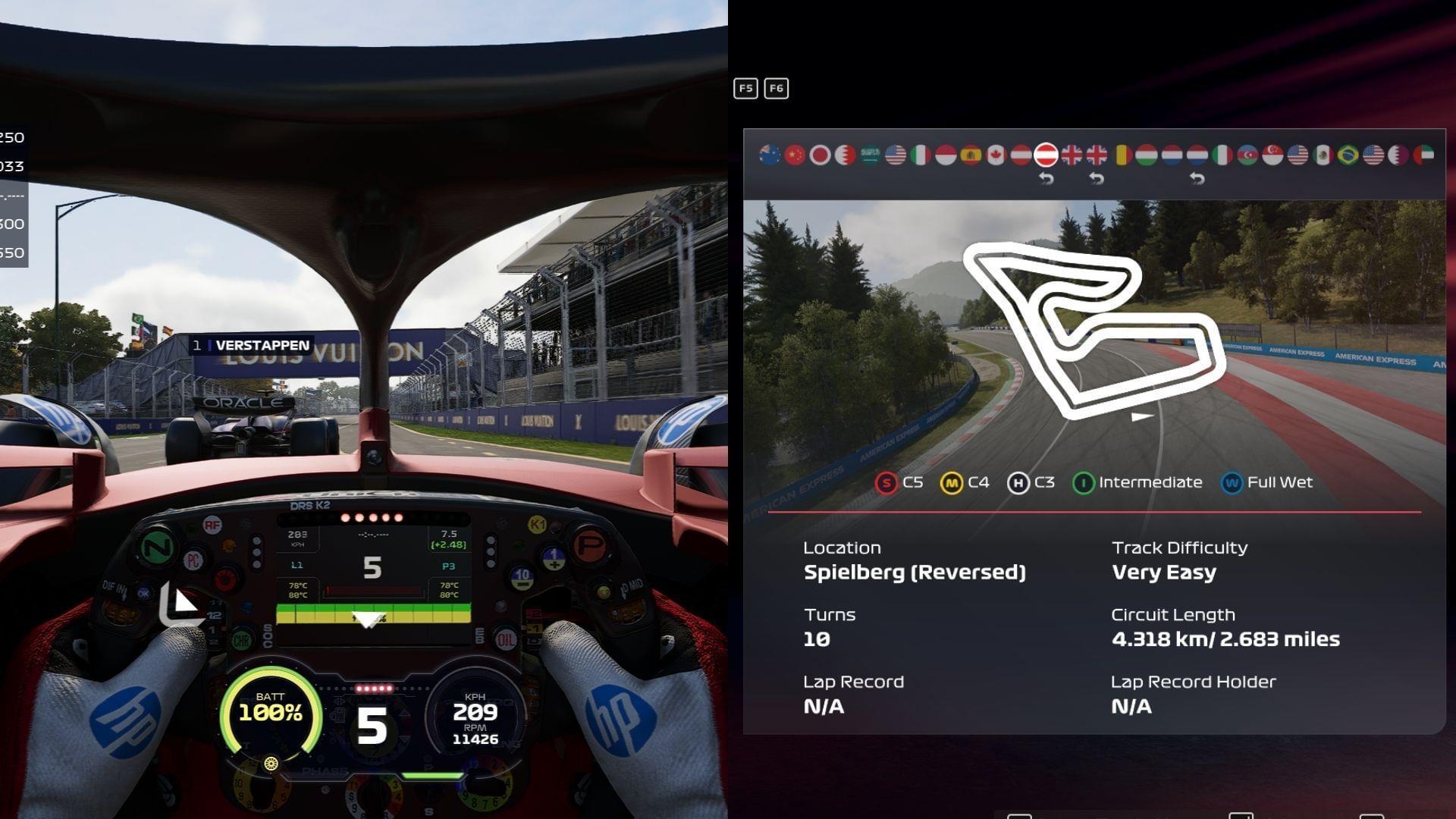
The Austrian Grand Prix at Spielberg’s Red Bull Ring presents one of F1 25’s most demanding circuits, blending high-speed straights with technically complex elevation changes. This legendary track features dramatic altitude variations that significantly impact car behavior and require precise driving techniques.
Navigating the Red Bull Ring successfully demands understanding three critical sections: the tight Turn 1 braking zone, the challenging off-camber Turn 3 that tests car balance, and the famous Rindt Curve requiring maximum commitment. Each section presents unique challenges that your car setup must address specifically.
The circuit’s combination of short straights and rapid direction changes means maintaining momentum is paramount. Unlike power-heavy tracks, the Red Bull Ring rewards drivers who can maintain minimum cornering speeds while maximizing exit acceleration onto the brief straights.
Optimized Car Setup Specifications
Here’s the meticulously tuned car configuration that delivers optimal performance at the Austrian GP:
- Differential Adjustment On Throttle: 100% – Provides maximum traction out of corners, essential for the circuit’s acceleration zones
- Differential Adjustment Off Throttle: 25% – Ensures stable braking and corner entry while maintaining rotation capability
- Front Anti-Roll Bar: 1 – Maximizes front-end responsiveness for quick direction changes without compromising rear stability
- Front Right Tire Pressure: 29.5 psi – Optimizes contact patch for right-hand dominant corners while maintaining heat management
- Front Left Tire Pressure: 29.5 psi – Balances the front axle for consistent turn-in response
- Rear Right Tire Pressure: 26.5 psi – Provides additional grip for traction zones while controlling tire temperature
- Rear Left Tire Pressure: 26.5 psi – Maintains rear axle balance through the circuit’s elevation changes
This configuration creates an ideal balance between mechanical grip and aerodynamic efficiency. The differential settings work synergistically with the carefully calibrated tire pressures to provide predictable behavior through the Red Bull Ring’s most demanding sections.
For drivers struggling with oversteer, consider reducing rear tire pressures by 0.5 psi increments. Conversely, if understeer is the issue, increasing front anti-roll bar stiffness to 2 can improve turn-in response without significantly compromising stability.
Advanced Racing Techniques and Strategies
Mastering the Red Bull Ring requires more than just the right setup—it demands precise execution of advanced racing techniques. The circuit’s unique characteristics reward drivers who can adapt their approach to each corner’s specific demands.
Cornering Mastery: Approach Turn 1 with late braking, carrying speed through the apex while preparing for the immediate direction change to Turn 2. For Turn 3, focus on smooth steering inputs and maintaining mid-corner speed—this off-camber corner punishes aggressive inputs. The Rindt Curve requires maximum commitment; trust your car’s downforce and carry as much speed as possible through this high-G force section.
Throttle Control: Progressive throttle application is critical throughout the lap. The circuit’s elevation changes mean traction varies significantly between corners. Practice modulating throttle between 50-75% on corner exits before going full throttle once the car is straight.
Overtaking Opportunities: The main overtaking zones are into Turn 3 and the final corner. Set up passes by getting a better exit from the previous corner to gain momentum down the straights. Defensively, protect the inside line into Turn 3 while maintaining minimum speed to prevent being vulnerable on the following straight.
Common Mistakes and How to Avoid Them
Even experienced F1 25 players often fall victim to predictable errors at the Red Bull Ring. Recognizing and avoiding these common mistakes can significantly improve your lap times and race results.
Braking Errors: Many drivers brake too early for Turn 3, sacrificing valuable time. The optimal braking point is just after the 100-meter board when carrying maximum speed. Similarly, braking too aggressively into Turn 1 causes lock-ups and compromises your line through the following complex. Practice threshold braking to find the perfect pressure point.
Throttle Application: Applying throttle too aggressively exiting Turn 3 causes traction loss and compromises speed down the following straight. The key is progressive application—smoothly increasing throttle as the car straightens rather than stomping on the accelerator.
Line Selection: Taking too narrow an approach to the Rindt Curve sacrifices exit speed onto the main straight. Use all available track width on entry and exit while maintaining minimum apex speed. Similarly, many drivers don’t use enough curb on the exit of Turn 1, costing valuable momentum.
Remember that consistent lap times often beat occasional fast laps. Focus on replicating your optimal lines and techniques lap after lap rather than pushing for one spectacular time.
No reproduction without permission:SeeYouSoon Game Club » Best F1 25 Red Bull Ring Setup for the Austrian GP Master the Red Bull Ring with this optimized F1 25 car setup and expert racing strategies