
TL;DR
- Horses spawn in plains/savanna biomes with 35 possible color/pattern combinations
- Taming requires repeated mounting with a temper system that increases success chances
- Breeding combines parent statistics to create superior offspring with optimized traits
- Different foods heal varying amounts – hay bales restore 20 hearts while sugar only heals 1 heart
- Statistics include health (15-30 hearts), speed (0.1125-0.3375), and jump strength (0.4-1.0)
Minecraft horses represent one of the most versatile transportation methods available in the game, offering not just mobility but also breeding potential and unique statistical variations that make each horse distinct.
While the Elytra provides superior late-game aerial mobility, horses remain essential during the early and mid-game phases. They deliver significantly faster travel than sprinting while conserving your hunger bar, making them ideal for exploration and resource gathering missions. These equine companions can be discovered in wilderness areas, domesticated through specific techniques, selectively bred for superior traits, and even equipped with protective armor for hazardous journeys.
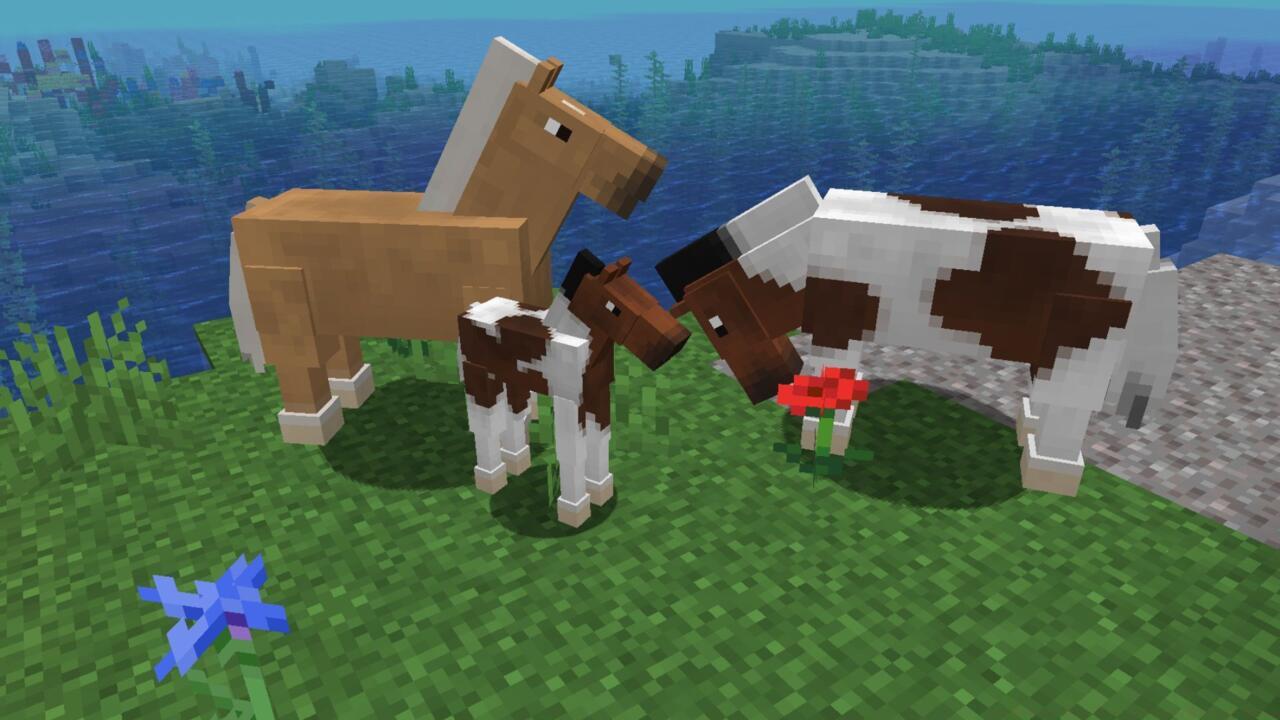
The diverse appearance options for Minecraft horses allow for personalization and identification
For players focused on optimization, understanding horse mechanics becomes crucial around the 10-20 hour mark, before acquiring Elytra capabilities. The time investment in mastering horse management pays dividends through improved exploration efficiency and reduced resource consumption.
Horses predominantly generate in plains and savanna ecosystems, appearing in social groups numbering from two to six individuals. You’ll also encounter them within village infrastructure, specifically in stables and animal enclosures regardless of the surrounding biome characteristics.
A critical spawning constraint involves illumination levels – these creatures won’t appear in areas where light intensity drops below nine in Java Edition or seven in Bedrock Edition. This makes well-lit open areas your primary hunting grounds for equine companions.
Minecraft horses come in several different colors
The equine population exhibits remarkable visual diversity, with seven base coat colors and multiple pattern overlays creating thirty-five distinct combinations. These chromatic variations include white, buckskin, flaxen chestnut, bay, black, and dapple gray, with each specimen potentially appearing as either mature adult or youthful foal.
Pro Tip: Focus your search during daylight hours and avoid dense forested areas where light levels naturally diminish. The savanna biome typically offers the most consistent horse spawning rates due to its open terrain and abundant lighting.
Domesticating your chosen equine companion involves persistent mounting attempts until acceptance occurs. Each horse possesses an internal temper metric ranging from zero to one hundred points. During initial mounting, the game randomly selects a threshold value between zero and ninety-nine – if the current temper exceeds this number, taming succeeds immediately.
.jpg)
Repeated mounting attempts gradually increase the horse’s acceptance likelihood
When the temper fails to meet the threshold, you’ll be forcefully dismounted and the temper increases by five points, making subsequent attempts more likely to succeed. This systematic approach ensures eventual domestication through cumulative patience.
Common Mistake: Many players abandon taming too quickly – most horses require 5-10 mounting attempts before successful domestication. The visual confirmation appears as heart particles emerging from the animal, though directional control remains impossible without saddle equipment.
Strategic taming involves selecting horses with desirable visual traits early, as appearance doesn’t correlate with statistical performance. This allows you to build your ideal stable aesthetic while focusing on statistical optimization through selective breeding later.
Establishing a successful breeding program requires previously tamed adult horses as participants. Initiate the reproduction process by providing each prospective parent with either golden apples or golden carrots until love mode activates, indicated by floating heart particles.
Feed horses to breed them
This nutritional stimulation triggers reproductive behavior, resulting in foal generation approximately five minutes after successful mating. For players interested in hybrid creation, crossbreeding horses with donkeys produces sterile mules that combine donkey inventory capacity with horse mobility traits.
Genetic Inheritance: Offspring inherit statistical attributes from both parents with slight variations, enabling systematic trait improvement across generations. Breeding two statistically superior horses typically requires 3-5 generations to achieve optimal results.
The breeding cooldown period lasts five minutes, during which horses cannot reproduce again. Optimal breeding strategy involves maintaining detailed records of parent statistics to predict offspring potential and avoid genetic regression.
Advanced breeders should consider creating specialized breeding facilities with separate enclosures for different statistical lines, allowing controlled genetic experimentation and trait preservation.
When your equine companion sustains injuries, appropriate nutrition facilitates recovery. Different food items provide varying therapeutic effectiveness, with some offering dramatically superior healing capabilities.
- Sugar – Restores 1 heart (minimal emergency healing)
- Wheat – Provides 2 hearts (basic recovery option)
- Apple – Heals 3 hearts (moderate therapeutic value)
- Golden carrot – Recovers 4 hearts (efficient healing resource)
- Golden apple – Regenerates 10 hearts (substantial medical treatment)
- Hay bale – Completely restores 20 hearts (maximum medical intervention)
Equine protective equipment includes armor crafted from leather, iron, gold, or diamond materials. Notably, horses cannot utilize Netherite armor unlike player characters. Leather armor represents the only craftable variant; other types must be discovered through exploration of generated structures containing loot containers.
Horse armor comes in different materials
Equipment Strategy: Reserve diamond armor for your statistically superior horses engaged in dangerous expeditions, while using iron or gold for general purpose protection.
Proper stable design should include secure fencing, adequate lighting, and separate healing stations stocked with appropriate medical supplies based on your horse’s value and intended usage.
Every horse possesses three core statistical attributes that demonstrate individual variation: health capacity, maximum movement velocity, and jumping potency. These characteristics establish themselves during birth or initial generation and remain unaffected by dietary intake. The game interface provides no direct statistical display, requiring empirical testing through practical evaluation.
Horses have varying jump strengths
Since statistical determination occurs at creation, systematic testing identifies superior attributes for selective breeding programs. For instance, pairing a speed-specialized horse with a high-jump specimen typically produces offspring combining both desirable traits within 2-3 generations.
Health
Equine vitality spans from fifteen to thirty heart containers. The visible heart display represents total health divided by two with downward rounding. Specimens with odd-numbered health values don’t display the final half-heart indicator. Testing methodology: if an unarmed attack removes half a heart, health is even-numbered; if no change occurs, health is odd-numbered.
Movement speed
Equine velocity ranges between 0.1125 and 0.3375 units. Considering standard player walking speed measures 0.1 units, horseback mobility already demonstrates clear advantage. Velocity modifications through status effects remain possible, though exact speed measurement requires comparative testing against known distances.
Jump strength
Similarly, jumping capability spans from 0.4 to 1.0, where maximum jump strength clears 5.25 blocks while minimum capability barely surpasses single-block obstacles. Construct one-block and five-block testing structures to visually assess potential jumping performance variations.
You can check your horse’s health above the toolbar
Advanced Testing Protocol: Create standardized test courses with measured distances and obstacle heights. Time travel between markers to calculate speed, document jump clearance heights, and monitor health during controlled damage scenarios.
When horses unfortunately perish under your stewardship, they yield up to two leather units, maximum three experience orbs, and any currently equipped protective gear.
Now that you’ve mastered equine management fundamentals, explore our Complete Guide for comprehensive gaming expertise, or dive into specialized content like our Weapons Unlock guide for weapon specialization strategies.
Action Checklist
- Locate horses in plains/savanna biomes during daylight hours
- Tame selected horses through repeated mounting (5-10 attempts typically required)
- Equip saddles for directional control and begin basic mobility training
- Establish breeding program with golden apples/carrots
- Test horse statistics through standardized courses and record performance metrics
- Optimize breeding pairs based on statistical performance
No reproduction without permission:SeeYouSoon Game Club » How To Find, Tame, Ride, And Breed Minecraft Horses Master horse taming, breeding, and statistics to create your perfect Minecraft companion