
TL;DR
- Bards excel as versatile support characters with exceptional social skills and combat flexibility
- Bardic Inspiration provides crucial combat and exploration bonuses that scale with character level
- Subclass choice dramatically impacts playstyle from pure caster to frontline fighter
- High Elf race offers optimal cantrip advantage while background choice enables roleplaying flexibility
- Charisma-focused stat distribution maximizes spell effectiveness and social interaction success
This comprehensive Baldur’s Gate 3 Bard guide delivers essential strategies for mastering one of the game’s most versatile classes, providing both foundational knowledge and advanced optimization techniques.
The Bard class in Baldur’s Gate 3 represents the pinnacle of adaptability, offering a perfect balance between accessibility for beginners and sophisticated mechanics that reward strategic thinking. Unlike more specialized classes, Bards provide consistent value across combat encounters, social interactions, and exploration phases.
What makes the Bard exceptionally powerful is their unique combination of spellcasting versatility, martial capability, and unparalleled skill proficiency. Their core identity revolves around the Jack-of-All-Trades feature, which grants a consistent bonus to every ability check your character attempts.
Bards naturally excel in Charisma-based activities, making them the ideal party face for persuasion checks, intimidation attempts, and deception scenarios. This social dominance extends beyond dialogue, influencing how your party navigates the world and interacts with NPCs.
A common misconception is that Bards serve only as support characters. In reality, their subclass system enables dramatic specialization, allowing you to build anything from a frontline combatant to a dedicated spellcaster. The key to Bard mastery lies in understanding how to leverage their flexibility to adapt to any party composition or combat situation.
Bard class mechanics emphasize straightforward progression while offering strategic depth through intelligent feature usage. The feature set focuses on enhancing party performance rather than individual power.
- Hit Points at level 1: 8 + Constitution modifier
- Hit Points at 5 + Constitution modifier
Bardic Inspiration represents the class’s signature ability, functioning as a targeted buff that significantly improves ally performance. This feature allows you to grant one companion an additional d6 die roll for their next attack, ability check, or saving throw.
Strategic application of Bardic Inspiration requires understanding combat timing and exploration mechanics. In combat situations, use it before allies attempt high-value attacks or crucial saving throws. During exploration phases, apply it before difficult skill checks where failure could have significant consequences.
A critical optimization tip: always control the character receiving Bardic Inspiration during exploration to ensure the bonus applies to their skill checks. Many players waste this resource by forgetting this mechanical requirement.
The scaling progression of Bardic Inspiration makes it increasingly valuable throughout your campaign. At level 5, the die upgrades to d8, and at level 10 it becomes d10, providing substantial late-game impact.
Bard Proficiencies
Bard weapon and armor proficiencies reflect their balanced approach to adventuring. While not specialized in heavy combat gear, they maintain sufficient capability to handle themselves in melee encounters.
- Light Armor
- Simple weapons
- Hand Crossbows
- Longswords
- Shortswords
- Rapiers
- Starting Instrument: Your choice of drum, lute, lyre, flute, violin
- Saving throws: Dexterity, Charisma
- Skills: Choose any three
- Spells: Choose 2 Cantrips
- Begins with 2 Level 1 Spell Slots

Cantrips provide consistent magical capability without consuming limited spell slots, making additional cantrip access incredibly valuable for sustained performance.
Skill selection strategy: prioritize Charisma-based skills like Persuasion, Deception, and Performance to maximize your social dominance, then select utility skills that complement your party composition.
Bard subclass selection at level 3 dramatically transforms your character’s capabilities and role within the party. Each College emphasizes different aspects of the Bard’s versatile toolkit.
College of Lore
College of Lore Bards specialize in knowledge and magical manipulation, gaining automatic proficiency in Arcana, Intimidation, and Sleight of Hand. Their progression includes additional spell slots and access to the powerful Magical Secrets feature at level 6, enabling access to spells from any class.
Advanced Lore Bard strategy involves using Cutting Words as a reaction to reduce enemy attack rolls, ability checks, or damage rolls. This makes them exceptional at controlling enemy effectiveness while supporting allies.
College of Valor
Valor Bards bridge the gap between martial and magical combat, gaining proficiency with medium armor, shields, and martial weapons. Their Combat Inspiration feature allows allies to use Bardic Inspiration to boost armor class or damage rolls.
Combat optimization for Valor Bards: position yourself as a secondary frontline fighter who can deliver spells and weapon attacks while providing combat support.
College of Swords
College of Swords Bards emphasize agile combat and performance, gaining proficiency with medium armor, scimitars, and expertise in Deception and Performance.
Swords Bard combat techniques include Blade Flourish maneuvers that provide defensive bonuses, area control, or additional attacks.
Advanced Swords Bard play involves using Mobile Flourish to reposition enemies strategically or Defensive Flourish to significantly boost your armor class for a turn.
Subclass selection mistake to avoid: don’t choose College of Swords if you want to focus purely on spellcasting, as their features emphasize martial enhancement.
Bard character creation requires balancing optimization with roleplaying preferences. While certain choices provide mechanical advantages, the class’s flexibility allows for significant customization.
Best Bard Race Selection
High Elf remains the optimal racial choice for Bards due to the additional cantrip slot, which provides significant long-term value. Additional benefits include immunity to sleep magic, darkvision capability, and advantage against charm effects.
- Extra cantrip slot
- Immune to sleep magic
- Can see in the dark
- Saving throw to protect against charm
Alternative race considerations: Drow or Tiefling provide broader weapon proficiencies but sacrifice the crucial cantrip advantage that defines optimal Bard performance.
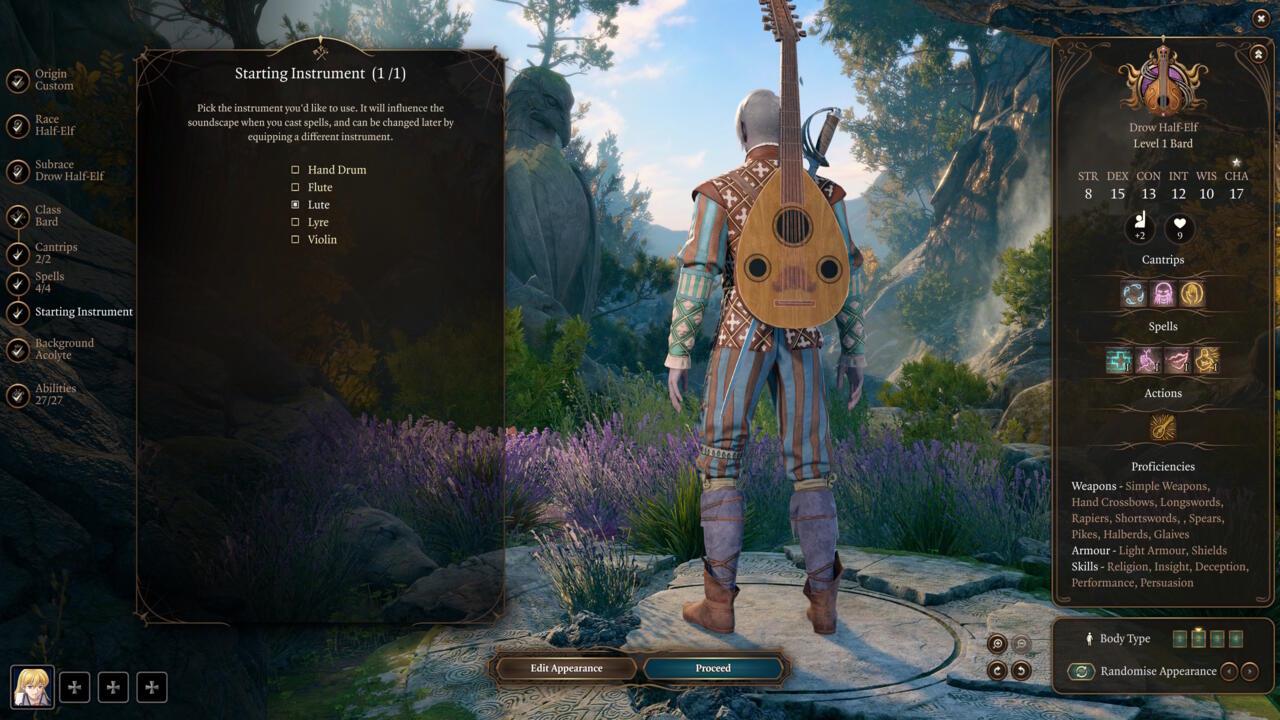
Instrument selection purely affects aesthetic presentation and roleplaying flavor without mechanical implications for your Bard’s capabilities.
Race selection timing: make your racial choice before considering subclass options, as certain race features synergize better with specific Colleges.
Best Bard Background Optimization
Background selection primarily influences roleplaying opportunities and inspiration gain conditions rather than combat effectiveness.
Recommended background options for mechanical optimization:
- Charlatan, for Sleight of Hand and Deception
- Entertainer, for Performance
- Guild Artisan, for Insight and Persuasion
Background strategy insight: while Noble provides interesting roleplaying potential with History and Persuasion proficiencies, it offers less direct combat utility than other options.
Optimal Bard Stat Distribution
The recommended starting stat distribution provides a solid foundation for most Bard builds:
- Strength – 8
- Dexterity – 15
- Constitution – 13
- Intelligence – 12
- Wisdom – 10
- Charisma – 17
Advanced stat optimization: for College of Swords builds, consider redistributing Intelligence points into Strength to enhance melee combat effectiveness.
Stat adjustment strategy based on playstyle: increase Dexterity for better armor class and initiative, or boost Constitution for improved concentration saving throws on sustained spells.
For comprehensive gaming strategies beyond Bard optimization, explore our Class Guide for detailed analysis of character specialization across different game systems.
Action Checklist
- Select High Elf race for optimal cantrip advantage and darkvision utility
- Choose College of Lore for spellcasting focus or College of Swords for martial hybrid builds
- Prioritize Charisma to 17 during stat distribution for maximum spell effectiveness
- Master Bardic Inspiration timing for combat advantage and exploration success
- Control inspired characters during exploration to ensure skill check bonuses apply
- Select background based on desired inspiration triggers and roleplaying preferences
No reproduction without permission:SeeYouSoon Game Club » Baldur’s Gate 3 Bard Class Guide Master Baldur's Gate 3 Bard class with expert strategies, subclass analysis, and character optimization tips