
TL;DR
- Horses spawn in plains/savanna biomes and village stables with specific light requirements
- Taming requires repeated mounting attempts and temper threshold mechanics
- Breeding combines parent statistics to create superior offspring with enhanced traits
- Healing uses specific food items with varying effectiveness – hay bales provide maximum healing
- Horse armor comes in four materials with diamond offering the best protection
Minecraft horses represent one of the most versatile transportation methods available in the game’s early and mid-game stages. These equine companions not only provide faster travel than sprinting but also conserve your hunger bar while offering breeding potential and customizable statistics. While the Elytra eventually surpasses horses for late-game mobility, horses remain invaluable for the first 20-40 hours of gameplay.
What many players overlook is that horses function as living storage units when equipped with chests (in the case of donkeys and mules), and their unique jumping capabilities make them ideal for navigating mountainous terrain that would otherwise require extensive tunneling or staircase construction. Each horse possesses individual statistics for health, speed, and jump strength, creating opportunities for players to breed specialized mounts tailored to their specific needs.
Where to find horses
Horses primarily generate in plains and savanna biomes where they appear in groups of two to six individuals. You’ll also discover them contained within village stables and pens across all biome types, though finding horses requires attention to environmental conditions. These creatures won’t spawn in areas where the light level falls below nine in Java Edition or seven in Bedrock Edition, making well-lit areas essential for natural spawning.
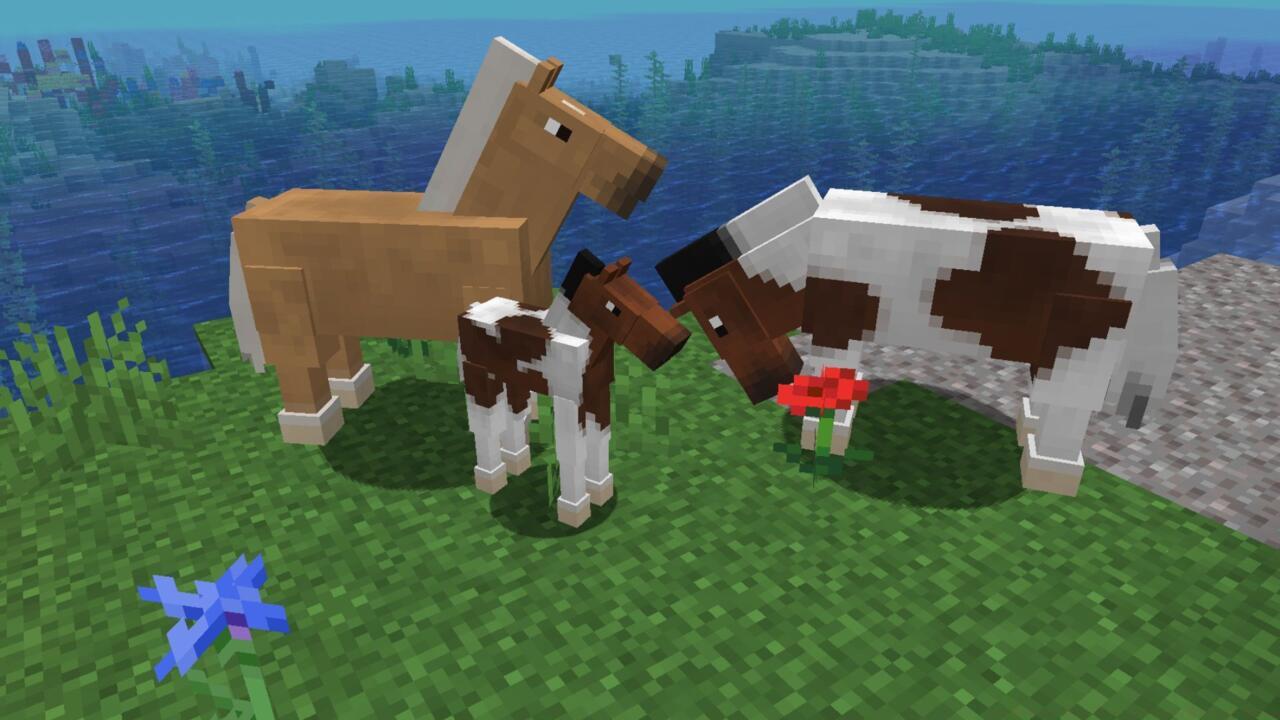
Minecraft horses come in several different colors
The equine population displays remarkable visual diversity with seven base colors: white, buckskin, flaxen chestnut, bay, black, dapple gray, and chestnut. When combined with the five available patterns—none, socks, stockings, blaze, and paint—players can encounter 35 distinct horse combinations. A common mistake is assuming all horses within a herd share identical statistics; in reality, each horse possesses unique attributes regardless of coloration.
How to tame horses
Successfully domesticating a horse involves a systematic approach to mounting attempts. When you first attempt to ride an untamed horse, the game establishes a random temper threshold between 0 and 99. Your horse begins with a temper level of 0, and each failed mounting attempt increases this value by five points. Once the temper exceeds the predetermined threshold, the horse becomes tame and displays heart particles.
.jpg)
Repeatedly mount a horse to tame it
A critical oversight many players make involves saddle placement timing. Even after successful taming, you cannot steer your mount without equipping a saddle. For optimal efficiency, have a saddle ready before beginning the taming process. Advanced players recommend attempting taming near enclosures or against natural barriers to prevent the horse from wandering during repeated mounting attempts.
While you will eventually be able to mount the horse and hearts appear, meaning it’s tamed, directional control remains impossible unless the animal wears a saddle. This limitation often surprises new players who assume taming alone grants full control.
How to breed horses
Establishing a successful breeding program requires understanding genetic inheritance mechanics. Both parent horses must be fully tamed before breeding becomes possible. Feed each horse either golden apples or golden carrots until love mode activates, indicated by floating heart particles. The resulting foal inherits averaged statistics from its parents with a slight random variation.
Feed horses to breed them
Strategic breeding involves identifying parent horses with complementary strengths—perhaps one excels in speed while another possesses superior jumping ability. Through selective pairing across multiple generations, you can develop horses that outperform any naturally spawned specimen. The foal produced through breeding typically demonstrates statistics approximately 20% superior to wild horses.
This breeding process causes them to enter love mode, resulting in a newborn foal. Cross-species breeding enables creating mules by pairing horses with donkeys, though these hybrids cannot reproduce further. For comprehensive breeding strategies beyond basic horse reproduction, consult our dedicated Complete Guide to advanced animal husbandry techniques.
How to heal horses
When your equine companion sustains damage, targeted feeding becomes your primary recovery method. Different food items provide varying healing effectiveness, with hay bales offering the most substantial health restoration. Here’s the complete breakdown of food healing values:
- Sugar – restores 1 heart
- Wheat – recovers 2 hearts
- Apple – heals 3 hearts
- Golden carrot – regenerates 4 hearts
- Golden apple – restores 10 hearts
- Hay bale – provides 20 hearts of healing
Emergency healing protocols recommend carrying at least two golden apples during dangerous expeditions, as these provide substantial recovery without requiring inventory space for multiple lesser items. Monitor your horse’s health bar displayed above your toolbar, and administer food before health drops below 25% to prevent accidental death from unexpected damage.
Horse armor
Equine protection comes in four distinct material types: leather, iron, gold, and diamond. Unlike player armor, horses cannot utilize Netherite protection. Leather horse armor represents the only craftable variant, while iron, gold, and diamond armor must be discovered through exploration of generated structures.
Horse armor comes in different materials
Diamond horse armor provides the highest damage reduction, though many players don’t realize that armor durability doesn’t decrease through normal use—it only degrades when the horse takes damage. This makes investing in superior armor particularly valuable for horses frequently exposed to hazardous environments.
Minecraft horse statistics
Every horse possesses three core statistics that determine its capabilities: health points, movement speed, and jump strength. These attributes are permanently established at spawn or birth and remain unaffected by feeding or environmental factors. Since the game provides no direct statistical display, assessment requires practical testing methods.
Horses have varying jump strengths
Through selective breeding based on statistical testing, you can develop horses that significantly outperform their wild counterparts. For instance, pairing a fast horse with a high-jumping specimen typically produces offspring combining both advantageous traits. Further breeding this hybrid with a health-rich parent creates a comprehensively superior mount.
Health
Equine health ranges from 15 to 30 hearts, with the displayed heart count representing health divided by two then rounded down. Horses with odd-numbered health values don’t display the final half-heart. Testing involves observing damage response: if an unarmed attack removes half a heart, the horse has even-numbered health; if no change occurs, its health is odd-numbered.
Movement speed
Movement velocity spans from 0.1125 to 0.3375, compared to the player’s standard walking speed of 0.1. Status effects can modify this speed, though no method exists to precisely quantify a horse’s movement statistic without external tools.
Jump strength
Jumping capability ranges between 0.4 and 1.0, where the maximum value clears 5.25 blocks and the minimum barely exceeds one block. Create test jumps using stacked blocks to compare different horses’ capabilities. While riding a saddled horse, tapping spacebar executes a standard jump, while holding it charges for maximum height—particularly useful for mountain scaling.
You can check your horse’s health above the toolbar
Horses serve multiple functions beyond transportation. Should your equine companion perish while under your care, it drops up to two leather, a maximum of three experience orbs, and any equipped armor. For advanced statistical optimization and Weapons Unlock strategies that complement your mounted combat capabilities, explore our specialized guides.
Now that you’ve mastered equine management in Minecraft, discover how to optimize your Class Guide for creating the perfect adventurer profile.
Action Checklist
- Locate horse herds in plains/savanna biomes or village stables
- Tame horses through repeated mounting attempts near enclosures
- Test horse statistics using block jumping courses and speed comparisons
- Breed horses with complementary statistics over 2-3 generations
- Equip diamond armor from structure looting for maximum protection
- Establish emergency healing protocols with golden apples for dangerous expeditions
No reproduction without permission:SeeYouSoon Game Club » How To Find, Tame, Ride, And Breed Minecraft Horses Master horse taming, breeding, and statistics to create the ultimate Minecraft transportation companion