
TL;DR
- Horses spawn in plains/savanna biomes and villages with specific light requirements
- Taming involves repeated mounting with temper mechanics determining success rate
- Breeding requires golden apples/carrots and allows genetic trait optimization
- Healing uses food items with varying effectiveness from sugar to hay bales
- Horse statistics vary individually and can be improved through selective breeding
Minecraft horses represent one of the most efficient early-game transportation methods available to players. While they’re eventually superseded by Elytra flight, horses provide superior speed compared to sprinting while conserving your hunger bar. These equine companions can be discovered in the wild, domesticated through taming, bred for superior traits, and even equipped with protective armor.
Locating horses requires understanding their spawning mechanics. They typically appear in plains or savanna biomes, forming herds that range from two to six individuals. Villages across all biomes frequently contain stables and pens housing horses. Critical to note: horses won’t spawn in areas with insufficient lighting—specifically requiring a light level of at least nine in Java Edition or seven in Bedrock Edition.
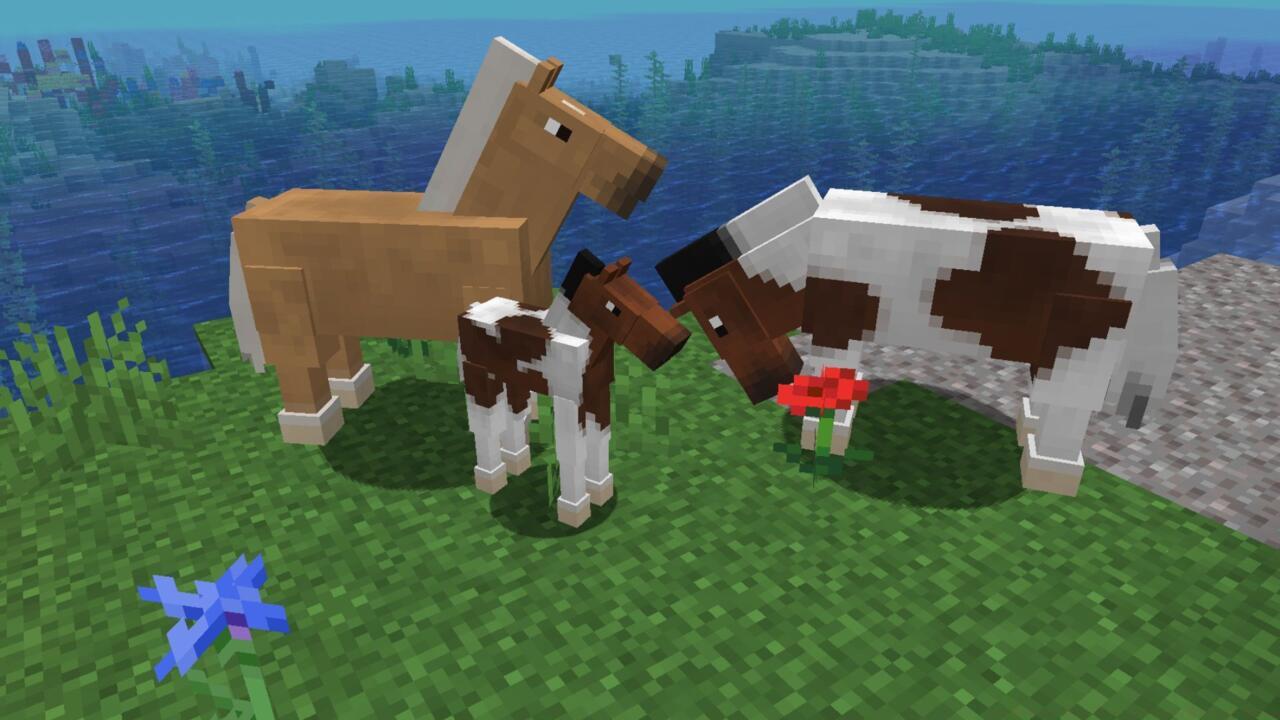
Minecraft horses display remarkable visual diversity with multiple color and pattern combinations
The equine population exhibits extensive variation in appearance, with horses spawning as either adults or foals. Available coat colors include white, buckskin, flaxen chestnut, bay, black, and dapple gray. When combined with the various patterns available, players can encounter 35 distinct horse combinations to match their aesthetic preferences.
Once you’ve identified your ideal equine companion, the taming process begins. Approach the horse and repeatedly attempt to mount it until acceptance occurs. This process relies on an internal temper system ranging from 0 to 100. Each initial mounting attempt generates a random threshold between 0 and 99. Success occurs when the horse’s temper exceeds this threshold; failure results in being bucked off while increasing temper by five points.
.jpg)
Persistent mounting attempts gradually increase the horse’s acceptance of your presence
Eventually, successful taming is indicated by heart particles appearing around the horse. However, a critical limitation remains: you cannot control the horse’s movement direction without equipping a saddle. Many players mistakenly believe taming alone grants full control, but directional management requires both taming and saddle application.
Pro Tip: Prepare multiple saddles before beginning your taming expedition. Horses in different biomes may require varying numbers of attempts, with savanna horses typically taming faster than plains variants. Avoid wasting time on horses that consistently buck you off—their initial temper may be too low for efficient taming.
Establishing a breeding program at your base allows you to develop horses with superior attributes. Both parent horses must be fully tamed before breeding attempts. Feed each horse either golden apples or golden carrots until heart particles appear, indicating they’ve entered love mode.
Proper feeding with golden items triggers the breeding response and produces a foal
This breeding process results in a newborn foal. For players interested in hybrid breeding, our Complete Guide covers crossing horses with donkeys to create mules—sterile hybrids that combine horse speed with donkey carrying capacity.
Advanced Strategy: Breeding horses with complementary strengths produces offspring that inherit the best traits from both parents. A fast horse bred with a high-jumping partner typically yields a foal excelling in both attributes. This genetic optimization process requires approximately 15-20 minutes per breeding cycle from preparation to foal maturity.
When your equine companion sustains injuries, feeding becomes the primary healing method. Different food items provide varying levels of health restoration, making some significantly more efficient than others for emergency treatment:
- Sugar – Restores 1 heart (moderate efficiency)
- Wheat – Heals 2 hearts (good early-game option)
- Apple – Recovers 3 hearts (readily available)
- Golden carrot – Provides 4 hearts (efficient mid-game)
- Golden apple – Restores 10 hearts (emergency recovery)
- Hay bale – Heals 20 hearts (maximum efficiency)
Emergency Protocol: Always carry at least two golden apples when exploring dangerous terrain. These provide immediate significant healing if your horse takes unexpected damage from falls, mob attacks, or environmental hazards.
Equine protection comes in the form of specialized armor crafted from leather, iron, gold, or diamond materials. Unlike player armor systems, horses cannot utilize Netherite armor. Leather horse armor represents the only craftable variant; superior iron, gold, and diamond armors must be discovered through looting chests in various world structures.
Different armor materials provide varying protection levels for your equine investments
Acquisition Tip: Focus on exploring desert temples, dungeons, and strongholds for the best chances of finding high-quality horse armor. Diamond horse armor offers the highest protection value, significantly reducing damage from hostile mob attacks and environmental hazards.
Every horse possesses three core statistics that vary individually: health points, maximum movement speed, and jump strength. These attributes are determined at birth or spawning and remain unaffected by feeding. The game provides no direct display of these values, requiring players to conduct practical tests for assessment.
Performance testing reveals the unique capabilities of each individual horse
Since statistics are genetically determined, selective breeding allows optimization. Test your horses to identify superior attributes, then breed complementary pairs. For instance, breeding a fast horse with a high-jumping partner typically produces offspring excelling in both areas. Further breeding such hybrids with health-optimized partners yields comprehensively superior horses.
Health
Equine health ranges from 15 to 30 hearts. Displayed hearts represent health divided by two and rounded down. Horses with odd-numbered health values don’t display the final half-heart. Testing methodology: if an unarmed melee attack removes half a heart, the horse has even-numbered health; if no half-heart loss occurs, health is odd-numbered.
Movement speed
Horse movement speed varies between 0.1125 and 0.3375. Compared to the player’s standard walking speed of 0.1, even the slowest horses provide transportation benefits. Speed can be modified by status effects, though no method exists for precise speed measurement without external tools.
Jump strength
Jump capability ranges from 0.4 to 1.0, where maximum jump strength clears 5.25 blocks while minimum strength barely exceeds one block. Create test courses with one-block and five-block obstacles to evaluate jump potential. While riding a saddled horse, tap the space bar for standard jumps; hold it to charge for maximum height—particularly useful for mountain navigation.
Monitor your horse’s health status displayed above the game toolbar during riding
While horses provide numerous advantages, should they perish under your care, they drop up to two leather, maximum three experience points, and any equipped armor. For comprehensive character development, consult our Weapons Unlock guide for weapon progression strategies that complement your transportation choices.
Statistical Optimization: The breeding process for creating a statistically perfect horse typically requires 4-6 hours of dedicated effort, involving testing, selective pairing, and maturation periods.
Action Checklist
- Locate horse herds in plains/savanna biomes or village stables
- Tame horses through repeated mounting attempts
- Equip saddles for directional control and begin basic riding
- Breed horses using golden apples/carrots to combine superior traits
- Test and document horse statistics for selective breeding programs
- Acquire and equip horse armor from dungeon loot
No reproduction without permission:SeeYouSoon Game Club » How To Find, Tame, Ride, And Breed Minecraft Horses Master horse taming, breeding, and statistics to create the ultimate Minecraft transportation companion