
TL;DR
- Oathbreaking provides new abilities without requiring evil alignment
- Each Paladin subclass has specific triggers for oath violation
- The Oathbreaker Knight appears in camp to offer dark powers
- Strategic timing maximizes benefits while minimizing early game weaknesses
- Oathbreaker abilities synergize well with necromancy and control spells
While many adventurers uphold their sacred promises in Baldur’s Gate 3, some Paladins discover greater power lies in forsaking their vows. This transformative path offers unique gameplay opportunities that diverge from traditional holy warrior archetypes.
The Paladin class stands among the most formidable choices in Baldur’s Gate 3, primarily due to the diverse capabilities granted through subclass selection. Your chosen oath fundamentally shapes how your character responds to narrative situations and constitutes a significant portion of your background identity. However, commitment to these vows remains optional—deliberate deviation opens the door to becoming an Oathbreaker Paladin, a specialized path with distinct advantages.
Electing to traverse this route results in losing access to oath-specific abilities while unlocking alternative powers and conversation choices. Understanding the precise mechanics of oath violation requires careful examination of in-game triggers and narrative decisions.
Critically, selecting the oathbreaking option doesn’t automatically align your Paladin with evil forces. While malevolent paths remain available, Oathbreaker Paladins typically seek liberation from restrictive codes to establish personalized moral frameworks. This distinction proves vital for players pursuing nuanced character development rather than simplistic alignment shifts.
Throughout your journey, you’ll encounter scenarios demanding choices between ethical righteousness and oath compliance. Following your conscience rather than your vow leads directly to Oathbreaker status. These pivotal moments often prove challenging to identify organically, necessitating strategic foreknowledge for optimal execution.

The moment of decision: embracing the Oathbreaker path
Each Paladin subclass demands distinct actions to trigger oath violation. Meticulous attention to subclass-specific requirements ensures successful transition to Oathbreaker status without unintended narrative consequences.
Oath of Devotion Violations: This path requires unwavering commitment to righteousness and protection of innocents. Breaching these principles involves:
- Intentionally slaying non-hostile NPCs or civilian characters
- Releasing the captive goblin Sazza within Emerald Grove enclave
- Eliminating both the adult Owlbear and its offspring in Owlbear Cave
- Supporting obviously corrupt factions against benevolent groups
- Permitting harm to come to those under your protection
Oath of the Ancients Transgressions: The official in-game description states “You fight on the side of light in the cosmic struggle against darkness to preserve the sanctity of life and the beauty of nature.” Violating this oath necessitates actions contrary to natural preservation and life affirmation:
- Desecrating natural sites or ancient groves
- Allying with blight-spreading entities like the Shadow-Cursed
- Destroying sentient natural beings without justification
- Supporting industrial expansion over ecological preservation
Oath of Vengeance Breaches: This subclass demands relentless pursuit of justice against wrongdoers. Betraying this oath involves:
- Showing mercy to proven villains or unrepentant evildoers
- Abandoning quests for retribution against clear antagonists
- Forming alliances with entities that have committed grave offenses
- Prioritizing personal gain over punitive justice
Strategic consideration: The optimal timing for oathbreaking typically occurs after reaching level 5, once you’ve acquired Extra Attack and second-level spells, minimizing early-game power depletion.
Following successful oath violation, the Oathbreaker Knight manifests at your camp during subsequent long rests. This mysterious figure serves as your gateway to dark powers and alternative abilities.
The knight presents dialogue options enabling you to fully embrace your new path or explore redemption possibilities. Critical conversations with this NPC unlock the Oathbreaker subclass features and provide narrative context for your transformed status.
Mechanically, this encounter transitions your Paladin from their original oath to the Oathbreaker specialization, replacing previous channel divinity options and spell selections with thematically appropriate alternatives.
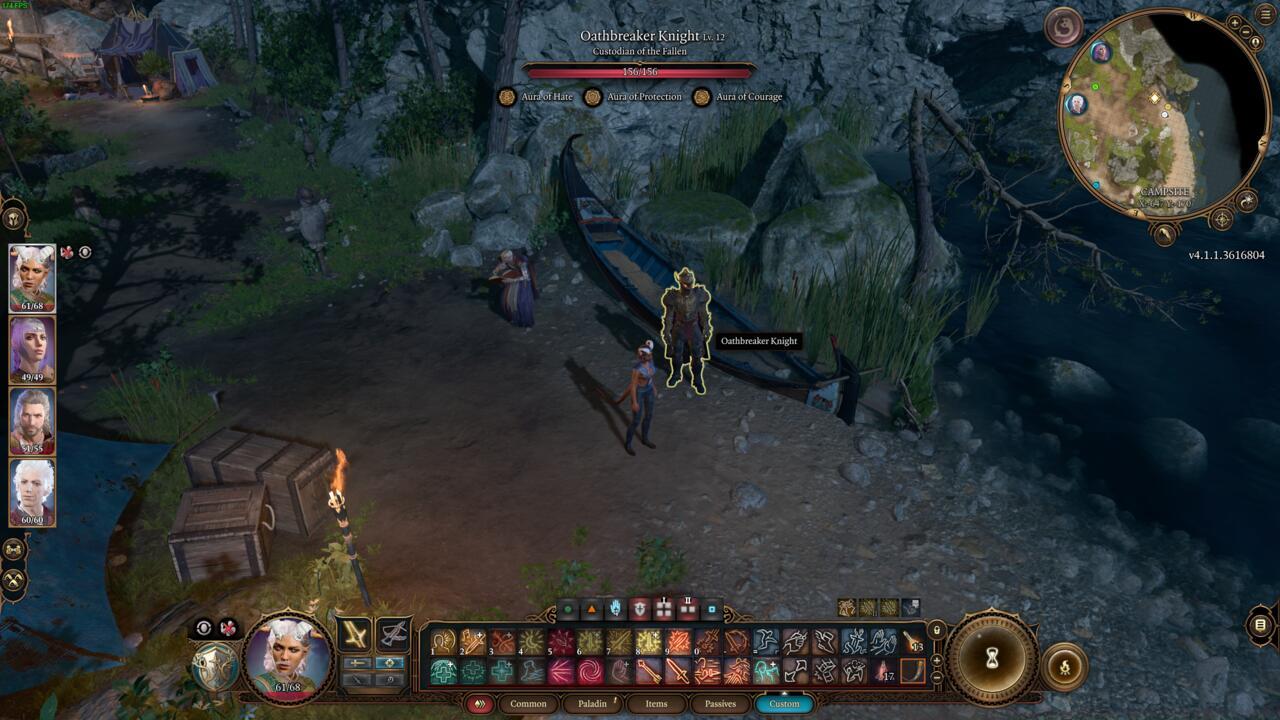
The Oathbreaker Knight arrives to guide your transformed path
New abilities include Control Undead, allowing command over hostile undead creatures, and Spiteful Suffering, which imposes significant debuffs on targeted enemies. These powers synergize exceptionally well with necromancy-focused party compositions.
Common mistake: Players often avoid speaking with the Oathbreaker Knight, mistakenly believing this prevents oathbreaking. In reality, conversation is mandatory to access replacement abilities.
Mastering the Oathbreaker path requires understanding nuanced gameplay implications beyond initial transformation. Strategic planning maximizes benefits while mitigating inherent weaknesses.
Timing Considerations: Breaking your oath during Act 1 provides maximum time to utilize new abilities but sacrifices early-game consistency. Conversely, late-game oathbreaking offers immediate power spikes but limited utilization window.
Party Composition Impact: Oathbreaker Paladins excel in groups containing spellcasters specializing in control and debuff effects. Their abilities complement specialized class builds focused on battlefield manipulation rather than direct damage.
Late Game Implications: At higher levels, Oathbreaker features like Aura of Hate provide substantial damage bonuses to nearby undead and fiends, creating powerful synergies with certain companion choices and summoning spells.
Pro tip: Before committing to oathbreaking, ensure you’ve completed any oath-specific quests that might become unavailable post-transformation. This prevents missing crucial narrative content or rewards.
The mechanical transition involves losing specific channel divinity options and oath spells while gaining dark alternatives. This trade-off typically favors players seeking unconventional tactical options over traditional paladin playstyles.
Action Checklist
- Identify your current Paladin subclass and specific oath requirements
- Execute at least one major violation aligned with your specific oath tenets
- Complete a long rest to trigger the Oathbreaker Knight encounter
- Engage with the Oathbreaker Knight to unlock new abilities
- Restructure your combat tactics around new Oathbreaker features
No reproduction without permission:SeeYouSoon Game Club » How To Become An Oathbreaker Paladin In Baldur’s Gate 3 Master the strategic path to becoming an Oathbreaker Paladin in Baldur's Gate 3 with tactical insights