
TL;DR
- Illithid Powers unlock after collecting three Mind Flayer Parasites from specific enemies
- Each parasite grants one point to spend in the branching skill tree accessed via ‘B’ key
- Strategic point allocation is crucial since powers are character-specific and points are limited
- Tier 1 powers must be unlocked before accessing more powerful Tier 2 abilities
- Companion integration requires persuasion checks, while some characters cannot use powers at all
Baldur’s Gate 3 introduces a unique progression system through Illithid Powers, granting characters psychic abilities derived from Mind Flayer parasites. These powers represent a significant departure from traditional class abilities, offering tactical options that can dramatically alter combat encounters and exploration possibilities.
The core mechanic revolves around tadpole infestation – characters hosting these parasites gain access to a specialized skill tree that emphasizes mental manipulation and psychic combat. Unlike conventional spells, these abilities draw upon the character’s connection to the Illithid hive mind, creating both narrative and gameplay consequences.
Strategic implementation of these powers requires understanding their resource economy. Each ability consumes either actions, bonus actions, or reactions, making coordination with your existing class abilities essential for maximum effectiveness.
Accessing the Illithid Powers system requires methodical progression through specific game milestones. The skill tree interface becomes available only after your character acquires their third Mind Flayer Parasite specimen, creating a natural pacing mechanism for this powerful feature.
Here are the essential mechanics for unlocking and utilizing these psychic abilities:
- The Illithid Powers panel remains locked until you collect three parasite specimens from designated enemies throughout the game world. These rare drops require strategic enemy targeting and thorough exploration.
- Once activated, the protagonist can allocate points by pressing the ‘B’ key to open the radial skill tree. Progression follows a branching structure where central Tier 1 abilities must be obtained before peripheral Tier 2 powers become accessible.
- Power acquisition operates on an individual character basis, demanding careful point distribution. Since parasite points represent a finite resource, prioritizing which companions receive enhancements becomes a crucial strategic decision.
- Companion integration presents additional complexity. While your main character automatically gains access, other party members require successful persuasion checks during dialogue interactions to embrace the psychic abilities.
- Certain companions, including Jaheira and Halsin, remain permanently excluded from this system due to their narrative circumstances preventing parasite infestation.


Left: You can persuade companions about the benefits of using Illithid Powers; Right: Some companions simply don’t have this mechanic available.
The Illithid Powers system organizes abilities into distinct tiers with progressive unlocking requirements. The visual representation shows synaptic connections between powers, where obtaining abilities closer to the center enables access to more distant, powerful options through these neural pathways.
Tier 1 Powers
- Psionic Overload (offensive action) – Attacks deal an additional 1-4 psychic damage, but you also take 1-4 psychic damage each turn.
- Favorable Blessings (passive) – The first attack roll or ability check you make against a target also gains a bonus equal to your proficiency bonus.
- Force Tunnel (offensive action) – Charge forward, pushing all objects and creatures away from you by four meters; does not provoke Opportunity Attacks.
- Concentrated Blast (offensive action) – Can deal 3d6 psychic damage; you must be concentrating on another spell to cast this. If the target is also concentrating, you heal as much as the damage dealt.
- Transfuse Health (support action) – Sacrifice half of your remaining hit points to heal a target for the same amount.
Tier 2 Powers
- Ability Drain (passive) – Once per turn when you make an attack roll, the attack reduces the target’s ability by 1 point. The ability that’s reduced corresponds to your attack (i.e., melee for STR, ranged weapons for DEX, and spells affect WIS, INT, or CHA).
- Luck of the Far Realms (passive) – When you make a successful attack roll, you can change that to a critical hit.
- Charm (passive) – Charm an enemy to prevent them from attacking you until the next turn; uses a reaction.
- Displace (passive) – Creatures that suffer fall damage due to your actions take 1-8 psychic damage.
- Repulsor (offensive action) – Deals 2d6 force damage and pushes your target back by six meters.
- Cull the Weak (passive/toggled) – Bringing an enemy down to fewer HP than your unlocked Illithid Powers automatically kills it; also deals 1-4 psychic damage to nearby creatures.
- Psionic Backlash (passive) – When an enemy within nine meters casts a spell, you can use your reaction to inflict 1d4 psychic damage per spell level.
- Shield of Thralls (support action) – Conjure a shield that gives a target 10 temporary HP; if the shield breaks, it can stun nearby enemies.
- Perilous Stakes (support action) – Empower a target to also heal whenever it attacks, though it also becomes vulnerable to all types of damage.
- Stage Fright (support action) – Targets have a disadvantage on attack rolls and they take 2-12 psychic damage whenever they miss; this is overcome if they succeed in an attack roll.
Strategic power selection significantly impacts combat effectiveness. Favorable Beginnings provides reliable accuracy improvement for initial attacks, while Luck of the Far Realms offers controlled critical hits – combining these creates devastating opening strikes. For comprehensive character building strategies, consult our Class Guide to maximize synergy between class features and Illithid enhancements.
Advanced progression becomes available during Act 3, where significant narrative developments enable further evolution of these psychic capabilities. Our specialized guides provide detailed analysis of these high-tier powers while maintaining appropriate spoiler warnings.
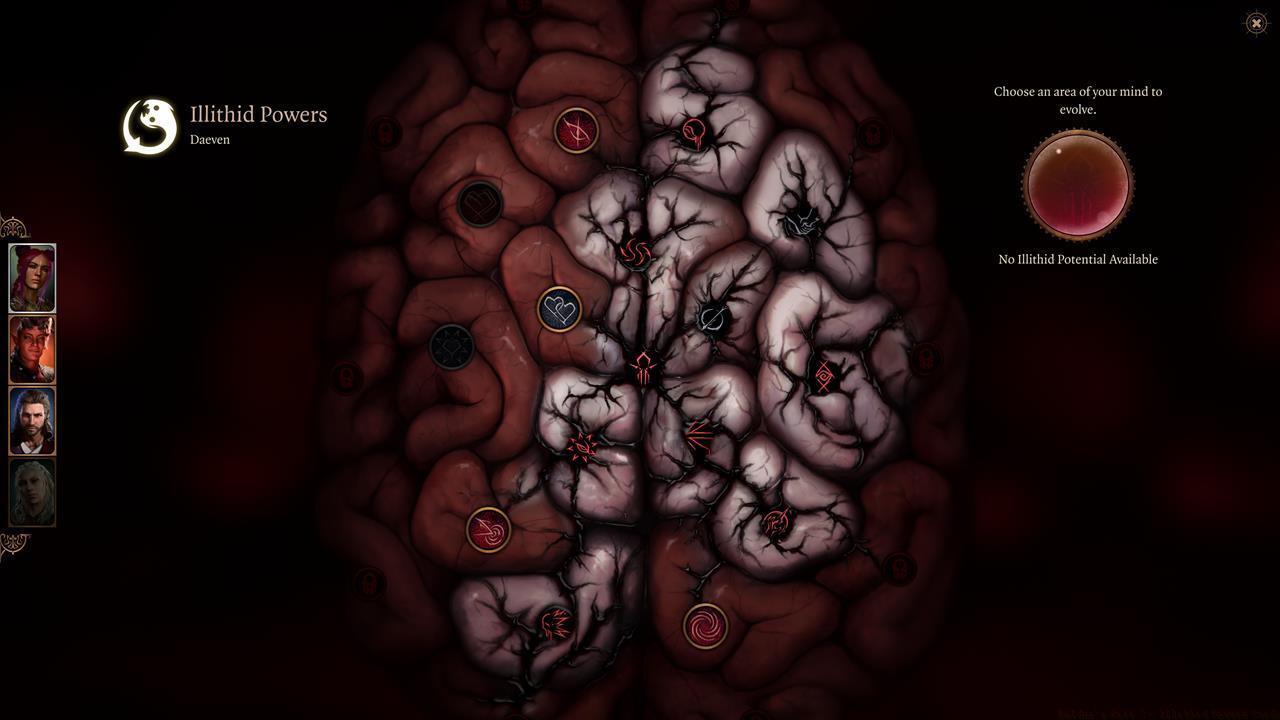
The nodes that you unlock can help you with the battles ahead.
The original Early Access implementation of Illithid Powers followed a completely different progression system tied to the True Soul/Illithid Wisdom mechanics. This required using Illithid Wisdom dialogue options at least twice during specific conversations to trigger the unlocking sequence.
Activation required completing a long rest at your camp after meeting the usage threshold. Party members would appear ill initially, but sleeping would trigger a visit from the Dreamlover character created during character creation, who then granted class-specific abilities.
Notably, the Early Access version applied these powers universally across all companions, including inactive party members. Each class received a unique ability that represented a corrupted version of their core mechanics, with most functioning as bonus actions to maintain combat flow.
List of Illithid Powers Per Class
These legacy abilities represented darker interpretations of each class’s fundamental role:
- Barbarian: Endless Rage – Deal +1d4 damage with each attack while Rage is active; receive +1d4 damage each turn; prevents Rage from prematurely ending since you’re guaranteed to take damage.
- Bard: Stage Fright – AoE effect where enemies have a disadvantage on attack rolls, and they also take damage when they miss; targets can overcome this effect once they succeed in an attack roll.
- Cleric: Survival Instinct – Heals for +3d4 HP if an ally reaches zero HP, preventing them from becoming unconscious.
- Druid: Aberrant Shape – Shapeshift into an Intellect Devourer that can deal psychic damage.
- Fighter: Psionic Pull – Pull one creature or object toward you.
- Paladin: Fracture Psyche – Decrease your target’s Armor Class (AC) by -1 point.
- Ranger: Force Tunnel – Charge and push away all objects and creatures along your path.
- Rogue: Inkblot – Create a cloud of magical darkness and immediately activate Hide.
- Sorcerer: Horrific Visage – Deal +1d4 damage for three turns to terrify a creature; gain +2 Sorcery Points.
- Warlock: Supernatural Attraction – Teleport to another infected creature.
- Wizard: Reflective Shell – Reflects all projectiles that target you for two turns.

Illithid Powers have a blood red icon, implying their dark and twisted nature.


Left: Fighter’s Psionic Pull; Right: Wizard’s Reflective Shell.
Mastering weapon selection complements your Illithid Powers strategy. Explore our Weapons Unlock guide to optimize your combat effectiveness through proper equipment choices.
Action Checklist
- Collect three Mind Flayer Parasites from specific enemies to unlock the skill tree
- Press ‘B’ key to access radial menu and allocate points strategically
- Prioritize Favorable Beginnings and Luck of the Far Realms for optimal combat performance
- Use persuasion checks to integrate willing companions into the power system
- Consult our comprehensive Complete Guide for advanced strategies
No reproduction without permission:SeeYouSoon Game Club » Baldur’s Gate 3 – Illithid Powers Guide Master the psychic abilities system in Baldur's Gate 3 with strategic parasite management and power optimization