
TL;DR
- Always refuel at your Auto Shop’s unlimited pump before expeditions
- Master vehicle-specific siphoning techniques for cars vs. trucks
- Prioritize Side Fuel Tank and Large Fuel Can upgrades early
- Plan routes around known gas station locations and vehicle clusters
- Carry emergency fuel reserves when exploring high-risk zones
Maintaining adequate fuel levels represents one of the most critical survival mechanics in Pacific Drive. Your vehicle serves as both transportation and sanctuary through the treacherous Olympic Exclusion Zone, making fuel management non-negotiable for successful expeditions.
When your car runs completely dry, the engine ceases operation entirely, stranding you in hazardous environments. This creates perilous scenarios where you must search for fuel sources on foot while environmental threats and anomalies close in. A depleted fuel tank often leads to catastrophic outcomes, especially during zone instability events when rapid evacuation becomes essential.
Understanding that fuel scarcity directly impacts survival odds will transform how you approach each journey. Strategic fuel planning separates successful drivers from those who become permanent residents of the exclusion zone.
While navigating Pacific Drive’s volatile regions, vigilant drivers will discover operational gas stations scattered throughout the landscape. These facilities provide reliable refueling opportunities when approached correctly.
Position your vehicle adjacent to a pump station and retrieve the nozzle apparatus. With the pump in hand, navigate to your car’s rear-left quadrant and engage the primary interaction control to commence refueling. The process continues automatically until your tank reaches maximum capacity or the station’s limited supply depletes.
Crucially, the Auto Shop headquarters features an infinitely replenishing fuel source. Make this your primary refueling point before embarking on any journey. Field-acquired fuel from exploration typically offers restricted quantities, making pre-trip refueling at your base essential for extended expeditions.
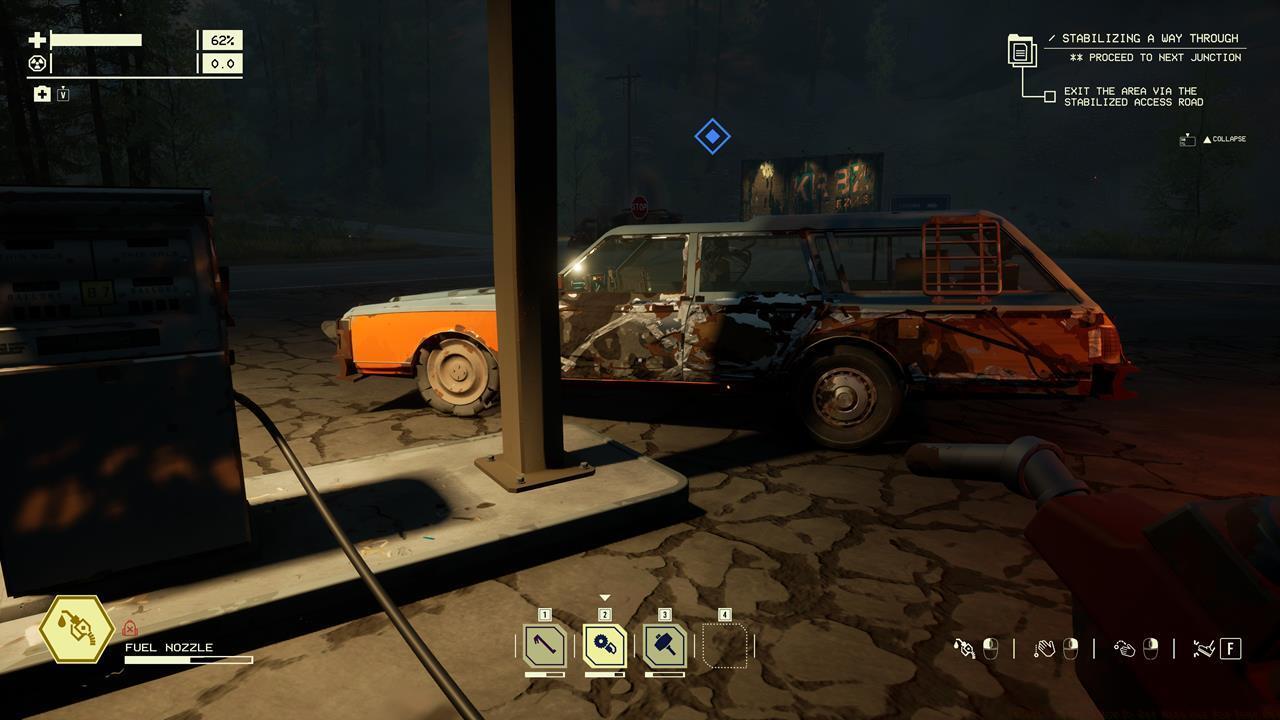
Fill up your car’s fuel tank whenever you see a gas station.
Professional drivers recommend creating mental maps of known station locations and incorporating them into route planning. Stations often cluster near key locations and landmarks, making them valuable navigation waypoints beyond mere refueling stops.
Salvaging gasoline from derelict automobiles provides another vital fuel acquisition method throughout Pacific Drive. When encountering abandoned transport along roadways, inspect the trunk compartment’s upper-left area to locate the Fuel Can container.
Retrieve this apparatus and transport it to the target vehicle’s fuel reservoir. Activate the primary interaction control to initiate the siphoning procedure, transferring residual fuel into your portable container.
Different vehicle types feature distinct fuel system configurations. Standard automobiles typically position tanks along the rear-left flank, while commercial trucks often mount cylindrical reservoirs toward the front-left or center-left sections. Once extraction completes, return to your own vehicle and deposit the acquired fuel into your tank.
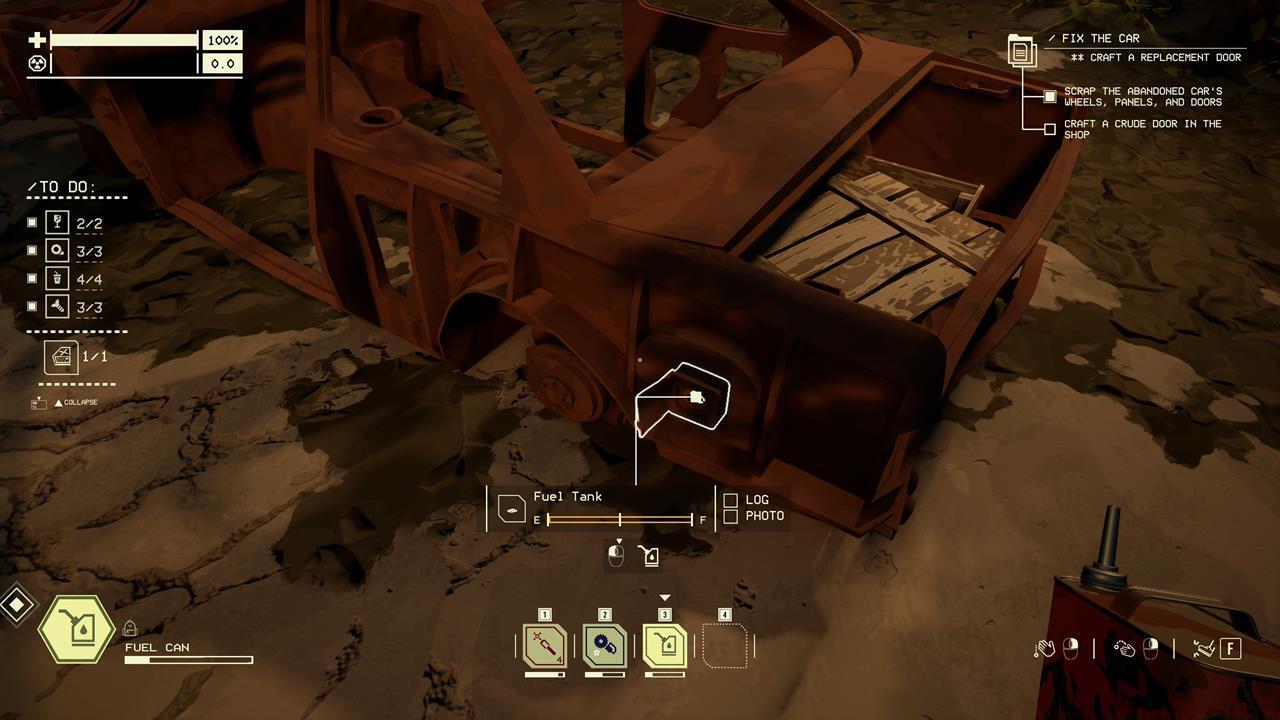
Gather leftover fuel from abandoned vehicles.
Advanced siphoning technique involves prioritizing vehicles showing minimal exterior damage, as these often retain more usable fuel. Trucks generally contain larger reserves than passenger vehicles, making them premium targets when available.
Vehicle enhancements represent the most sustainable solution to fuel management challenges. Access the Fabrication Station within your headquarters to review available blueprints in the Fuel category, navigable using the ‘Q’ and ‘E’ directional controls.
Key early-game improvements include:
- Side Fuel Tank – Installs auxiliary gasoline storage mounted along your vehicle’s side panels; prerequisites include: Basic Workbench, installed Scanning Antenna (rooftop placement), constructed Side Rack (vehicle attachment), researched Steel Sheet technology, 1x Fabric material, and 0.8 Stable Energy units
- Large Fuel Can – Enhances siphoning capacity by increasing Fuel Can container volume; requires: Basic Workbench, operational Scanning Antenna, 1x Fabric, and 0.7 Stable Energy
- Fuel Synthesizer – Advanced apparatus that harvests ambient environmental compounds and transmutes them into usable fuel; necessities include: Advanced Workbench, Side Rack installation, researched Circuit Board technology, scanned ARDA Fuel Tanker data, 1x Fabric, and 0.7 Unstable Energy
Unlock upgrades that grant additional fuel for your car.
Upgrade progression follows logical sequencing: begin with capacity expansions (Side Tank), then improve collection tools (Large Can), finally implementing generation systems (Synthesizer). This approach ensures continuous fuel availability progression throughout your Pacific Drive campaign.
Seasoned exclusion zone drivers develop sophisticated fuel conservation strategies that dramatically extend operational range. One essential technique involves planning circular routes that begin and end at your Auto Shop, incorporating known fuel sources along the circuit.
Common fuel management errors include:
- Underestimating consumption during off-road travel
- Failing to refuel at stations when above half-tank
- Neglecting to scan vehicles for fuel potential before passing
- Overlooking upgrade research dependencies
For advanced optimization, maintain at least 25% fuel reserve when exploring unfamiliar territories. This buffer provides emergency evacuation capability when encountering unexpected hazards or rapidly deteriorating zone conditions.
When preparing for our comprehensive Battlefield 6 Complete Guide, consider how fuel management parallels resource strategies in other survival games. The principles of anticipating needs, planning reserves, and implementing scalable solutions translate across gaming domains.
Action Checklist
- Always refuel to maximum at your Auto Shop before departing
- Scan all encountered vehicles for siphoning potential before moving on
- Research and construct Side Fuel Tank upgrade as first priority
- Map gas station locations and incorporate into route planning
- Maintain 25% fuel reserve when exploring unknown territories
No reproduction without permission:SeeYouSoon Game Club » Pacific Drive – How To Get More Gas For Your Car Master fuel management strategies and advanced upgrades to survive Pacific Drive's dangerous zones