
TL;DR
- Slimes spawn in specific underground chunks below layer 40 or swamp biomes during full moons
- Large slimes require 3×2.1×3 clear spawning space and split into smaller versions when damaged
- Slimeballs enable essential crafting recipes including sticky pistons, leads, and magma blocks
- Combat effectiveness increases with sweeping edge swords and strategic positioning
- Advanced farms use chunk borders and controlled spawning conditions for maximum yield
Minecraft Slimes represent a unique hostile mob category that provides valuable Slimeball resources upon defeat. These gelatinous cubes offer essential components for numerous advanced crafting recipes throughout the survival experience.
.jpg)
The distinctive green cubic form of Minecraft Slimes makes them immediately recognizable, though their behavior patterns require careful study.
Slimes exhibit specialized spawning behavior exclusively within the Overworld dimension. They generate in predetermined slime chunks located beneath layer 40, with coordinate display helping players identify optimal hunting locations. Unlike standard hostile mobs, Slimes ignore light level restrictions entirely. Additionally, swamp and mangrove swamp biomes between layers 51-69 support Slime spawning when illumination drops below level 8. Weather patterns don’t influence their appearance. During full moon phases in swamp environments, spawn rates significantly increase, while new moons completely prevent generation. Mushroom fields and deep dark biomes never host Slime populations.
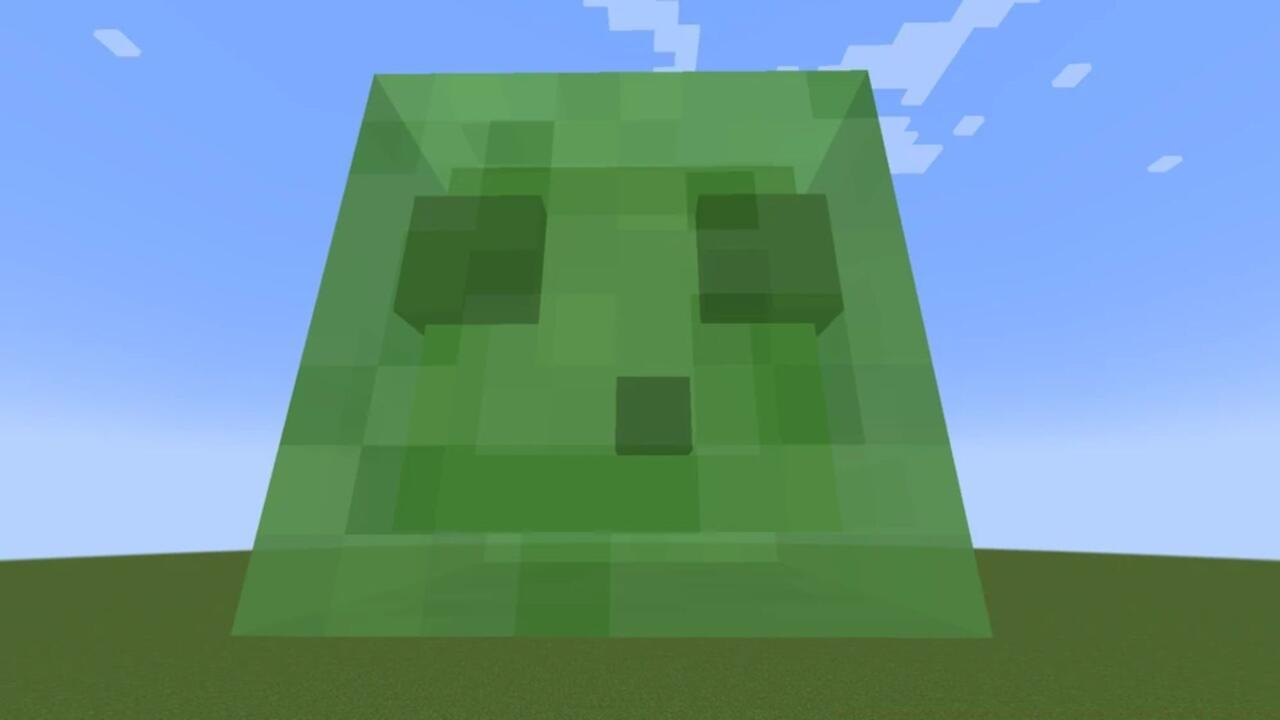
Size progression in Slimes demonstrates remarkable range, with maximum specimens reaching extraordinary dimensions.
Spawning mechanics enforce a 24-block minimum distance from players, with gradual despawn occurring beyond 32 blocks. Immediate despawn triggers at 128-block ranges in Java Edition, while Bedrock Edition uses variable distances from 44-128 blocks depending on simulation settings.
Successful Slime generation demands a clear 3×2.1×3 area without obstructions. The game validates space availability before determining Slime size. Since large variants exceed two-block heights, they cannot spawn in confined spaces. Their width similarly prevents generation near even minimal barriers like glass panes.
World difficulty directly influences Slime size distribution. Easy mode provides equal 33% chances for each size category, while higher difficulties shift toward larger specimens with 16% small, 33% medium, and 50% large probabilities.
Mastering Slime location requires understanding both chunk-based and biome-specific spawning systems. Slime chunks comprise approximately 10% of all underground chunks below layer 40, creating natural hunting grounds. Advanced players utilize external tools or meticulous mapping to identify these rare generation zones.
Swamp biome hunting proves most effective during full moon phases, when spawn rates triple compared to other lunar cycles. Strategic positioning at layer 52-68 optimizes encounter rates while maintaining safety from other threats.
.jpg)
Multiple Slimes congregating in swamp environments demonstrate ideal hunting conditions during optimal moon phases.
Effective farming designs incorporate several key elements: precise chunk alignment verified through coordinate monitoring, comprehensive area illumination to suppress competing hostile mobs, and strategic player positioning maintaining optimal spawn-despawn balance.
Common Hunting Mistakes to Avoid:
- Building farms at incorrect Y-levels (must be below 40 for chunks or 51-69 for swamps)
- Overlooking moon phase influences in swamp biomes
- Using insufficient spawning platforms within identified chunks
- Positioning too close (prevents spawning) or too far (triggers despawn)
- Neglecting to light surrounding areas, allowing other hostile mobs to interfere
Advanced optimization techniques include creating multi-layer spawning platforms within chunk boundaries, implementing efficient collection systems using water streams or hoppers, and designing AFK-friendly configurations that maintain proper player positioning.
Slime combat requires adapting strategies based on enemy size. Small Slimes pose minimal threat with only ½ heart damage, while medium specimens deal 1 heart, and large variants can inflict substantial 4.5 heart attacks. Each size category demands different tactical approaches.
Weapon selection significantly impacts combat efficiency. Swords with Sweeping Edge enchantments prove exceptionally effective against groups of smaller Slimes. For larger specimens, high-damage weapons like diamond or netherite swords accelerate elimination before they can divide.
Size-Specific Combat Strategies:
- Large Slimes: Focus on eliminating before division; use knockback to maintain distance
- Medium Slimes: Manage groups systematically; prioritize targets based on proximity
- Small Slimes: Utilize area-effect attacks; don’t waste powerful weapons on minimal threats
Defensive positioning proves crucial when engaging multiple Slimes. Elevated platforms or strategic barrier placement prevents being overwhelmed by dividing enemies. Always maintain escape routes when confronting large groups.
Environmental advantages can turn difficult encounters into manageable situations. Luring Slimes into water slows their movement, while creating choke points limits how many can attack simultaneously.
Slimeballs represent the primary resource obtained from defeating Slimes, with drop rates varying by size. Small Slimes guarantee 0-2 Slimeballs, medium variants drop 1-4, while large specimens provide the most substantial yields. Understanding these drop mechanics enables efficient resource farming.
Essential Slimeball Crafting Applications:
- Sticky Pistons: Essential for redstone contraptions and automated systems
- Leads: Crucial for animal transportation and management
- Magma Blocks: Create bubble columns for transportation and mob farms
- Slime Blocks: Enable innovative redstone mechanisms and safe falling
Advanced applications include creating elaborate piston doors, sophisticated flying machines, and efficient item transportation systems. The unique properties of slime blocks allow for bounce mechanics and entity movement in complex redstone creations.
For players seeking comprehensive combat mastery, our BF6 Weapons Unlock Guide provides additional strategic insights for managing hostile encounters across different game environments.
Resource optimization strategies involve calculating approximate Slimeball yields per hour based on farm design, spawn rates, and combat efficiency. Well-designed farms can produce 2-4 stacks of Slimeballs hourly, sufficient for most crafting needs.
Strategic resource allocation ensures you maximize the value of collected Slimeballs. Prioritize sticky pistons for essential redstone mechanisms before investing in decorative or secondary applications.
Action Checklist
- Identify slime chunks using external tools or coordinate mapping below Y=40
- Construct optimized spawning platform with 3-block clear height and proper lighting
- Farm during full moon phases in swamp biomes for triple spawn rates
- Implement efficient collection system using water streams and hoppers
- Craft essential items: sticky pistons, leads, and slime blocks
No reproduction without permission:SeeYouSoon Game Club » How To Find And Use Minecraft Slimeballs, Defeat Slimes, And Farm Slime Blocks Master Slime hunting strategies, combat techniques, and essential Slimeball crafting recipes in Minecraft