
TL;DR
- Settlers remain the primary expansion method but require careful resource management and strategic positioning
- Commander abilities like Roma’s Legatus provide alternative settlement creation every three levels
- Independent villages offer diplomatic absorption opportunities through cultural influence or military force
- Conquest of rival civilizations provides immediate settlement acquisition but carries diplomatic consequences
- Advanced strategies include multi-continent expansion and specialized town development for optimal empire growth
In Civilization VII, settlements form the backbone of your empire’s expansion and economic power. Understanding the distinction between towns and cities is crucial for effective long-term strategy development and resource allocation.
Your journey begins with a single settlement during the Antiquity Age, which serves as your civilization’s capital. As you progress through different eras, you’ll have opportunities to establish additional settlements that can evolve from towns into full-fledged cities. Towns typically specialize in specific production types—such as food generation, resource extraction, or research output—while cities become industrial powerhouses capable of constructing monumental structures and supporting larger populations.
The transition from town to city represents a significant strategic decision with distinct advantages and trade-offs. Cities consume more maintenance resources but provide greater production capacity and defensive capabilities. Strategic settlement placement near resources, defensive terrain, and trade routes can dramatically impact your civilization’s development trajectory and competitive positioning against rival factions.
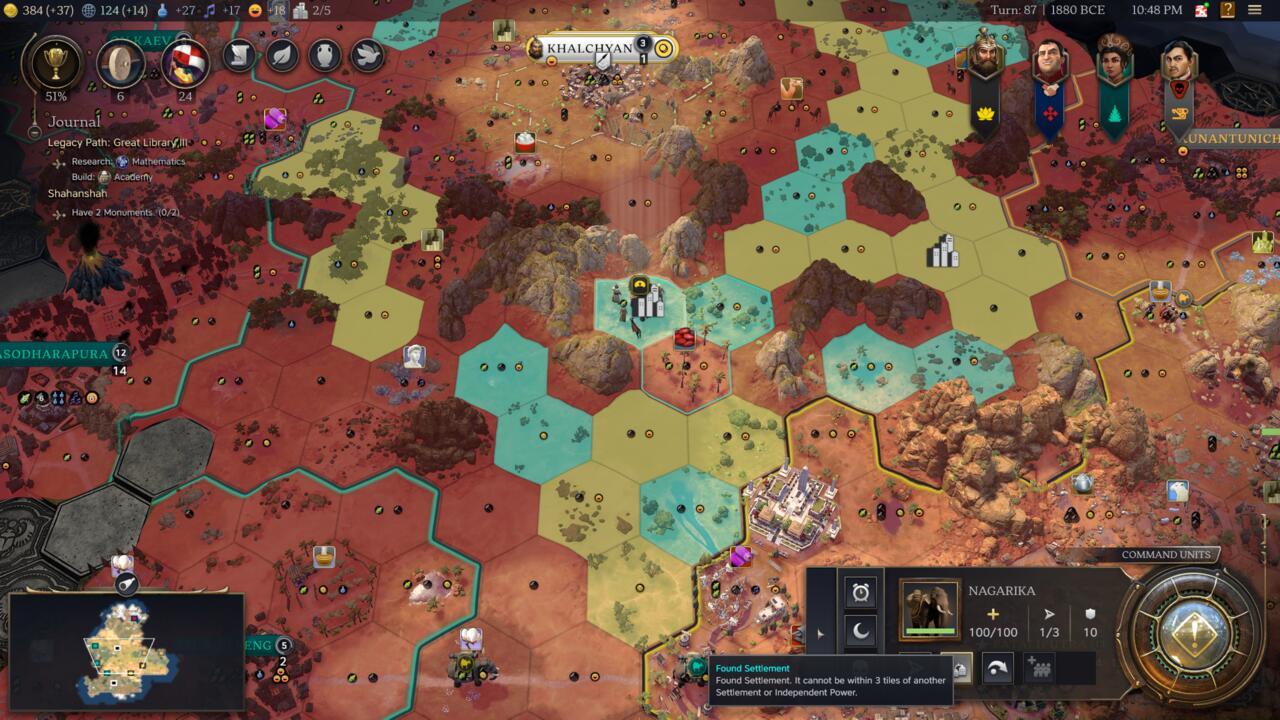
Strategic Settler deployment requires careful planning and risk assessment
The Settler unit represents your most reliable method for territorial expansion throughout the game. Unlike military or scout units that you control directly, Settlers operate through a placement interface that allows you to select optimal locations within explored territory. Production timing is critical—creating Settlers too early can stunt your capital’s development, while delaying expansion leaves valuable territory vulnerable to competitor acquisition.
Location selection demands careful evaluation of multiple factors. The game’s recommended settlement spots, marked by the distinctive two towers icon, typically indicate locations with balanced resource access, defensive advantages, and growth potential. However, experienced players often identify superior positions by analyzing resource distribution, terrain features, and strategic choke points that may not be immediately obvious to beginners.
Settler units face significant risks during long-distance travel, particularly when crossing water or hostile territory. Damage accumulation can result in unit loss before settlement establishment, wasting valuable production time and resources. As you advance to later ages, the game increasingly encourages intercontinental expansion, which substantially increases both the rewards and risks associated with settlement creation.
Beyond standard Settler units, certain Commanders possess unique abilities to establish settlements without consuming population or production resources. Roma’s Legatus commander stands out with the capability to found a new settlement every three experience levels gained, providing a powerful alternative expansion mechanism that complements traditional settlement strategies.
The Legatus settlement ability offers distinct advantages over conventional methods. These special settlements can be established anywhere within your explored territory, bypassing the movement limitations and vulnerability of Settler units. This makes them particularly valuable for securing strategically important locations quickly or establishing footholds in dangerous regions where Settlers would struggle to survive the journey.
Timing your Legatus level-ups to coincide with strategic expansion opportunities can dramatically accelerate your empire’s growth. Planning military engagements or exploration routes to maximize experience gain before critical expansion phases can provide substantial strategic advantages. Other commanders may offer similar capabilities, though their specific mechanics and limitations require individual assessment based on your chosen civilization and playstyle.

Independent villages present multiple integration pathways
Military dispersion of independent settlements
Independent villages scattered throughout the map represent valuable expansion opportunities through either diplomatic assimilation or military conquest. Culturally absorbing these settlements requires sustained influence through religious presence, trade routes, or policy decisions, gradually converting them into loyal towns within your empire without resource expenditure.
Military conquest of rival civilizations provides the most direct method for rapid settlement acquisition. Successful military campaigns can net multiple established settlements simultaneously, though this approach carries significant diplomatic consequences and typically requires substantial military investment. When capturing enemy settlements, you face the critical decision of whether to incorporate them into your empire or destroy them to deny territory to competitors in future conflicts.
Diplomatic negotiations can yield settlement concessions
Diplomatic negotiations during peace talks can sometimes yield settlement concessions from defeated or strategically weaker opponents. This approach typically requires leveraging military victories or economic superiority to persuade rivals to cede control of strategically valuable territories.
Strategic decisions when acquiring settlements through conquest
Managing your settlement network requires balancing expansion with development resources. Each new settlement initially functions as a town with specialized production capabilities, while conversion to city status unlocks expanded construction options at the cost of increased maintenance requirements. This decision should align with your overall strategic objectives and available resources.
Optimal settlement distribution considers defensive positioning, resource access, and trade route optimization. Concentrated settlement clusters facilitate defense and infrastructure development but increase vulnerability to widespread disruption from natural disasters or military incursions.
Advanced players should develop settlement specialization strategies that align with their chosen victory condition. Research-focused civilizations might concentrate scientific towns near mountains, while culturally ambitious empires position settlements to maximize tourism potential from natural wonders and world heritage sites. Understanding these specialization principles can dramatically improve your efficiency in working toward specific victory conditions.
Action Checklist
- Produce your first Settler after establishing basic infrastructure (3-4 turns)
- Scout extensively to identify optimal settlement locations before committing Settlers
- Position Legatus commanders to gain levels near expansion opportunities
- Evaluate independent villages for cultural absorption versus military conquest
- Develop specialized town networks aligned with your chosen victory condition
No reproduction without permission:SeeYouSoon Game Club » Civilization 7: How To Get More Settlements Master Civilization 7 settlement expansion through four strategic methods and expert empire-building techniques