
TL;DR
- Tiller provides 10% crop price boost and superior level 10 specializations for most playstyles
- Rancher offers 20% animal product bonus but requires significant barn/coop investment
- Early game crop focus makes Tiller more immediately profitable for new farmers
- Profession changes cost 10,000g at the Statue of Uncertainty in the Sewers
- Artisan specialization at level 10 Tiller provides the highest profit ceiling
Reaching farming level 5 represents a pivotal career decision point where you must commit to a specialized agricultural path. This milestone unlocks your first major profession choice that will significantly influence your farm’s economic trajectory throughout the game.
When your cultivation expertise reaches the fifth tier in Stardew Valley, the game presents two distinct career advancement options that define your farming approach. The Rancher or Tiller decision at farming level 5 carries substantial weight since agricultural activities form the backbone of income generation in the valley. One specialization centers on livestock management while the alternative focuses on crop cultivation. Your optimal selection depends heavily on your established play patterns and long-term farm vision.
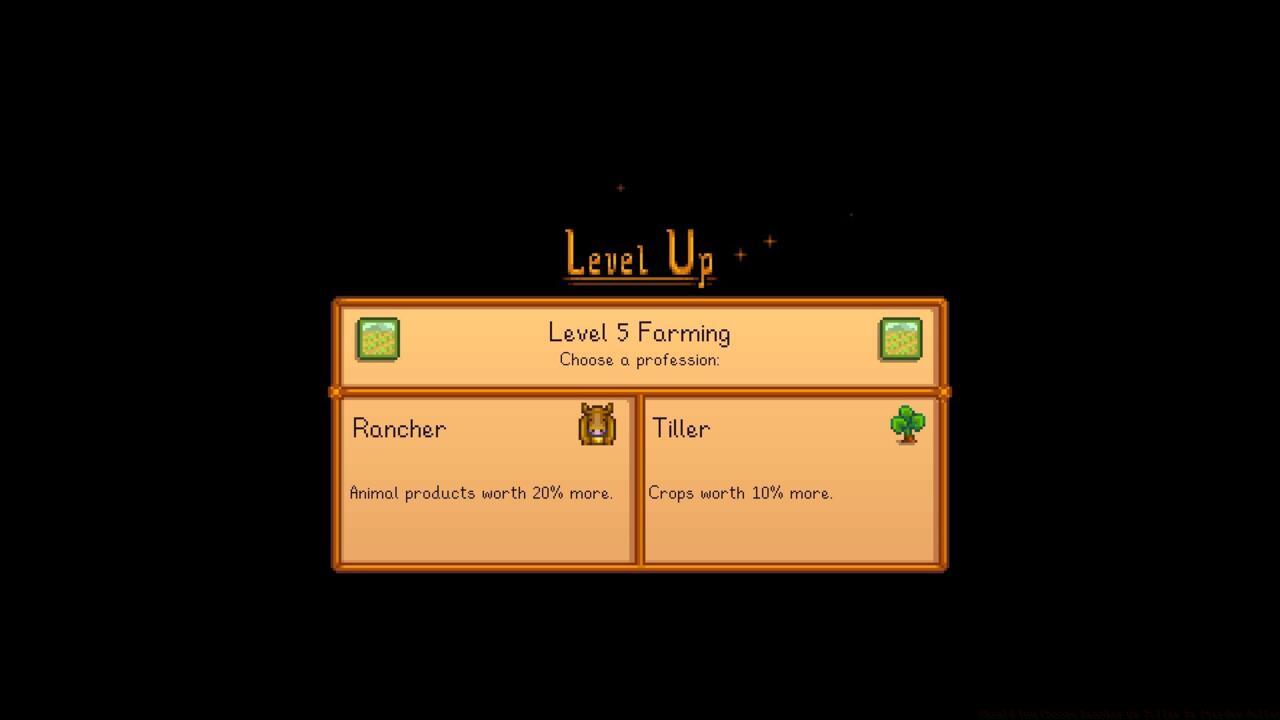
At level 5 you will have to choose a profession, but you can change it later for fee.
For the majority of agricultural strategies, Tiller delivers superior profit enhancement and unlocks more advantageous level 10 specialization routes.
The Rancher profession enhances animal-derived revenue by 20%, applying to both basic products like eggs and milk, as well as processed goods including cheese and mayonnaise. Meanwhile, Tiller elevates the market value of all cultivated crops by 10%, though this bonus exclusively affects farm-grown produce rather than foraged vegetation.
While the numerical advantage appears to favor Rancher at surface level, the practical implementation reveals a different story. Most players discover they’ve invested significantly more in crop infrastructure than animal husbandry by the time they reach this decision threshold. The 20% multiplier sounds impressive but applies to a much smaller revenue stream compared to your seasonal harvest shipments.
Seasonal planning becomes crucial here – spring strawberry investments, summer blueberry fields, and fall cranberry operations typically generate substantially higher volume than early-game animal operations. This volume differential often makes the smaller percentage boost more lucrative in actual gold generation.
At level 5 you face this profession commitment, though the decision isn’t permanently binding – you can reverse it later for a financial penalty.
Two primary factors explain Tiller’s general superiority for standard playthroughs. First, typical agricultural progression means most farmers possess minimal livestock investments when they reach level 5, assuming consistent seasonal planting. Despite Rancher’s larger 20% premium, your animal product sales volume typically falls far short of crop shipment quantities each season. The secondary consideration involves the enhanced level 10 specializations available to each path.
A common mistake new players make is overestimating animal profitability without considering the substantial upfront costs. Constructing coops and barns requires significant gold and resource investment, while crops only need seeds and tilled soil. This makes Tiller the safer choice for players still establishing their farm’s economic foundation.
Advanced players should note that crop scaling happens much faster than animal operations. While animals provide consistent daily income, high-value crops like ancient fruit and starfruit in the greenhouse can generate exponentially higher returns with the Tiller bonus.
The initial Rancher level 10 specialization, Coopsmaster, reduces egg incubation periods, facilitates bonding with coop animals, and improves chances for higher quality coop products. The alternative option, Shepherd, accelerates sheep wool production, eases barn animal friendship development, and increases probability of superior quality barn animal goods. Both choices reward dedication to specific animal categories, but one Tiller level 10 specialization delivers substantially greater economic impact.
Tiller’s level 10 options include Artisan, which provides a massive 40% price increase on all artisan goods including wines, cheeses, and oils. This creates incredible synergy with both crop and animal operations later in the game. The alternative Agriculturist speeds crop growth by 10%, allowing more harvest cycles per season.
The Artisan profession particularly shines when combined with kegs and preserve jars processing high-value crops. Ancient fruit wine with both Tiller and Artisan bonuses can generate over 2,000g per bottle, creating the highest profit potential of any farming specialization.
For players focusing on the optimization strategies found in other game systems, the mathematical advantage of Artisan becomes undeniable for min-max players.
When evaluating your profession path, consider your current farm development stage and future goals. Players with established barns and coops might find Rancher appealing, but those planning greenhouse operations or extensive crop fields will benefit more from Tiller.
Time investment also plays a crucial role – animal care requires daily attention while crops need periodic maintenance. This makes Tiller ideal for players who prefer batch processing rather than daily chores.
Remember that profession changes require visiting the Statue of Uncertainty in the Sewers with 10,000g. This reset option provides flexibility but comes at a significant cost during early game when gold is scarce.
For comprehensive strategic planning similar to other complex game systems, consider creating a save backup before committing to either profession to test both paths.
Additional Stardew Valley resources:
How To Unlock The Skull Cavern In Stardew Valley
How To Unlock The Skull Cavern In Stardew Valley
Mastering these profession choices is as crucial as understanding progression systems in other games – the right choice accelerates your advancement dramatically.
Action Checklist
- Track your crop vs animal revenue for first two seasons before level 5
- Calculate infrastructure costs for expanding animal operations vs crop fields
- Plan your level 10 specialization path before committing at level 5
- Save 10,000g as profession change insurance before reaching level 5
- Test both paths with save backups if uncertain about long-term strategy
No reproduction without permission:SeeYouSoon Game Club » Should You Choose Rancher Or Tiller In Stardew Valley Strategic guide to choosing between Rancher and Tiller professions in Stardew Valley for maximum profit optimization