
Understanding Apex Legends’ Ranked matchmaking gaps, why they happen, and practical strategies to adapt and succeed despite them.
The Rank Gap Phenomenon: Not a Bug, But a Feature
If you’ve recently booted up Apex Legends and found yourself questioning the skill level of players in your Ranked match, you’re not alone. The experience of a Bronze-tier teammate appearing in your Platinum lobby, or vice versa, has become a frequent point of discussion. This isn’t a new glitch haunting Season 13; it’s a persistent design element that Respawn Entertainment has openly addressed.
Respawn Entertainment developers have clarified that perceived matchmaking irregularities are often working as intended, serving the critical purpose of maintaining healthy queue times for all 60 players in a lobby.
For years, the Apex community has reported jarring encounters where a player seemingly several ranks out of their depth appears in a match. This creates an imbalance that can feel unfair for both sides: the higher-skilled team gets a perceived handicap, while the lower-skilled player faces a brutal and discouraging experience. Respawn’s consistent position is that these instances, while visible, are statistically rare. Their necessity stems from a core tenet of live service gaming: player retention hinges on the ability to find a game quickly. A perfectly fair match that takes 15 minutes to start is often less desirable than a slightly imbalanced one that begins in 2 minutes.
 Respawn Entertainment
The matchmaking system prioritizes filling lobbies to ensure games start promptly, which can sometimes lead to rank variance. The reality is that at any given moment, the system is trying to assemble 60 players of similar skill. When it can’t find enough, it must decide between making players wait longer or broadening the search criteria.
Inside the ‘Edge Cases’: When and Why Mismatches Happen
Live Technical Designer Aaron ‘Exgeniar’ L. provided a rare look under the hood, distinguishing between acceptable and unintended rank gaps. His explanation centers on two primary scenarios: premade parties and off-peak population.
The most common source of a visible rank disparity is a premade party with a wide internal rank spread. Exgeniar specified, “In all the cases we checked, it is a Gold Player in a premade with a Bronze player that gets placed into a Gold + Plat lobby.” The system attempts to average the party’s skill and find a suitable match, which can place the lower-ranked Bronze player into a higher-skilled environment. He also established a clear boundary: “Bronze player could get matched with a platinum player in some intended edge cases… However, Bronze player should never be matched with a Diamond+ player.” This rule is crucial for understanding what is a design limit versus a potential system error.
The second scenario is purely time-based. “Sometimes when queue time is sufficiently high, lobbies start merging to kick off games,” Exgeniar noted. This is the system’s fail-safe. During early morning hours or in less populated server regions, the player pool shrinks. Rather than have the few players online wait indefinitely, the matchmaker gradually expands its search until it can form a viable lobby. This means a Diamond player queuing at 4 AM might eventually be grouped with Platinum and even high Gold players to start a game. He emphasized, “This is a compromise in the design because we don’t want these players to wait forever… This is fully intended.”
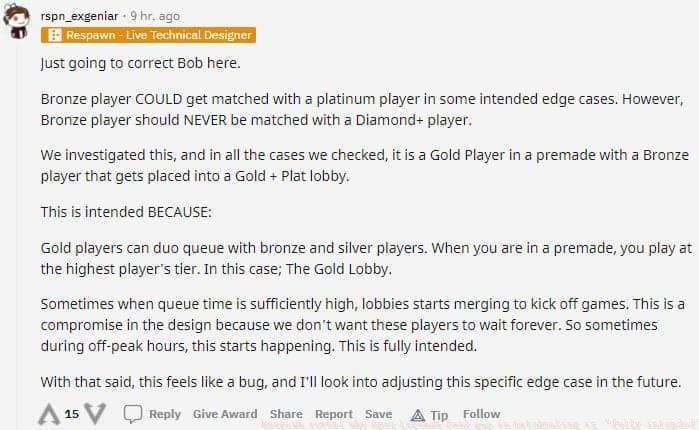 via Reddit
Community discussions often highlight these edge cases, prompting developer clarification. This clarification came after an EA Help representative mistakenly stated that Bronze and Platinum players should never meet, highlighting the gap between frontline support and the nuanced reality of the game’s systems.
Player Strategies: How to Thrive in Mismatched Lobbies
Knowing why rank gaps occur is only half the battle. The savvy Apex Legends player can adopt specific strategies to mitigate the disadvantage and even turn these situations into learning opportunities or unexpected wins.
If You’re the Lower-Ranked Player: Your role shifts from fragger to supporter. Stick close to your highest-ranked teammate. Focus on providing covering fire, pinging enemy locations meticulously, managing heals and ammo for your squad, and playing legends with supportive abilities (like Lifeline, Newcastle, or Seer). Your goal isn’t to win the 1v1 against a Platinum player, but to ensure your team’s best player has the information and space to do so. Use this as a high-intensity training session—observe how better players position themselves and rotate.
If You’re the Higher-Ranked Player: Leadership is key. You must quickly assess the capabilities of your lower-ranked teammates. Give clear, simple directives (“Hold this door,” “Loot fast and follow me”). Assume they may not have advanced map knowledge or rotation timing. Choose a legend that can control the flow of battle or provide an escape (like Horizon, Valkyrie, or Gibraltar). You may need to play more cautiously, as your team’s overall damage output and survivability might be lower than you’re accustomed to.
Universal Adaptation Tactics: Communication is non-negotiable. Use your microphone or ping system aggressively. Adjust your drop strategy—contesting a hot drop with a skill-disparate team is often a recipe for disaster. Aim for a quieter drop spot to gear up safely. Prioritize survival over risky kills. Playing for placement and accruing RP through survival time can be a more reliable strategy in these mixed lobbies than hunting for high-kill games.
Common Pitfalls & How to Avoid Matchmaking Frustration
Many players inadvertently increase their chances of experiencing these frustrating matchmaking outcomes through common, avoidable mistakes.
Pitfall 1: Queuing Solo During Off-Peak Hours. This is the most direct path into a merged lobby. If you’re playing late at night or very early in the morning, consider queuing with a premade squad you know. If you must solo queue, mentally prepare for a wider range of teammate and enemy skill levels, and adjust your expectations for match fairness accordingly.
Pitfall 2: Ignoring Your Premade Squad’s Rank Composition. If you are a Platinum player wanting to play with a Bronze friend, you must accept that you will likely be placed in a lobby averaging around Gold skill. The system isn’t broken; it’s calculating the average. Before queuing, have an honest discussion about whether everyone is prepared for that challenge. Perhaps run some unranked matches first to gauge synergy.
Optimization Tip: Schedule your ranked sessions during peak server hours for your region (typically evenings and weekends). The larger player pool allows the matchmaker to be more selective, leading to tighter skill-based matches. Use community Discord servers or the Apex Legends club feature to build a network of players at a similar rank, reducing reliance on the solo queue and its inherent variances.
Pitfall 3: Tilting and Blaming Teammates. Encountering a rank mismatch is frustrating, but directing anger at the lower-skilled player is counterproductive. They didn’t choose to be in your lobby; the system placed them there. Use the energy to focus on your own gameplay and the adaptable strategies outlined above. A positive attitude in a difficult match can sometimes be the difference between a loss and an unlikely, morale-boosting win.
The Future of Apex Matchmaking & Community Expectations
Exgeniar’s transparency is a positive sign that Respawn is both aware of and actively examining these friction points. He admitted the experience can feel like a “bug” and that the team is looking into ways to “ease these fringe instances.”
The path forward is a complex balancing act. Any solution must weigh player demand for fair matches against the imperative of quick queue times. Potential long-term improvements could include more granular regional matchmaking settings, a more sophisticated party skill-averaging algorithm, or even a voluntary “strict matchmaking” toggle that accepts longer queues for tighter skill ranges. However, players should temper expectations: the core compromise between speed and perfection is unlikely to vanish entirely in a game requiring 60 players per match.
The community’s role is to provide clear, constructive feedback based on understanding the system’s constraints. Reporting a Bronze player in a Diamond lobby as a potential bug (which violates the stated design rule) is helpful. Complaining about a Gold/Platinum mix during a 3 AM queue is less so, as that is the system functioning as intended to provide any game at all. Moving forward, an informed player base that understands these “edge cases” can better adapt its play, provide targeted feedback, and ultimately enjoy a more consistent Apex Legends experience, even when the matchmaking isn’t perfect.
No reproduction without permission:SeeYouSoon Game Club » Respawn reveal why Apex Legends Rank gap in matchmaking is “fully intended” Understanding Apex Legends' Ranked matchmaking gaps, why they happen, and practical strategies to adapt and succeed despite them.