
TL;DR
- Evil Dead uses dual progression: character-specific leveling and account-wide Spirit Points
- Collections menu houses skill trees with branching upgrades for survivors and demons
- Survivors unlock passives at levels 10/25, demons at 15/25/45
- Spirit Points provide cross-character progression to mitigate balance issues
- Strategic skill point allocation and milestone planning optimize progression efficiency
Master the intricate leveling mechanics that power Evil Dead: The Game’s asymmetrical horror experience.
Asymmetrical horror games consistently struggle with balance dynamics, particularly regarding survivor capabilities versus demonic entity strength and progression pacing. Evil Dead: The Game addresses these challenges through an innovative dual-leveling architecture that separates character-specific advancement from account-wide progression systems.
While Evil Dead’s progression systems don’t reinvent the genre, their implementation creates meaningful strategic depth. The true innovation lies in how these systems interact to maintain competitive equilibrium while rewarding player investment.
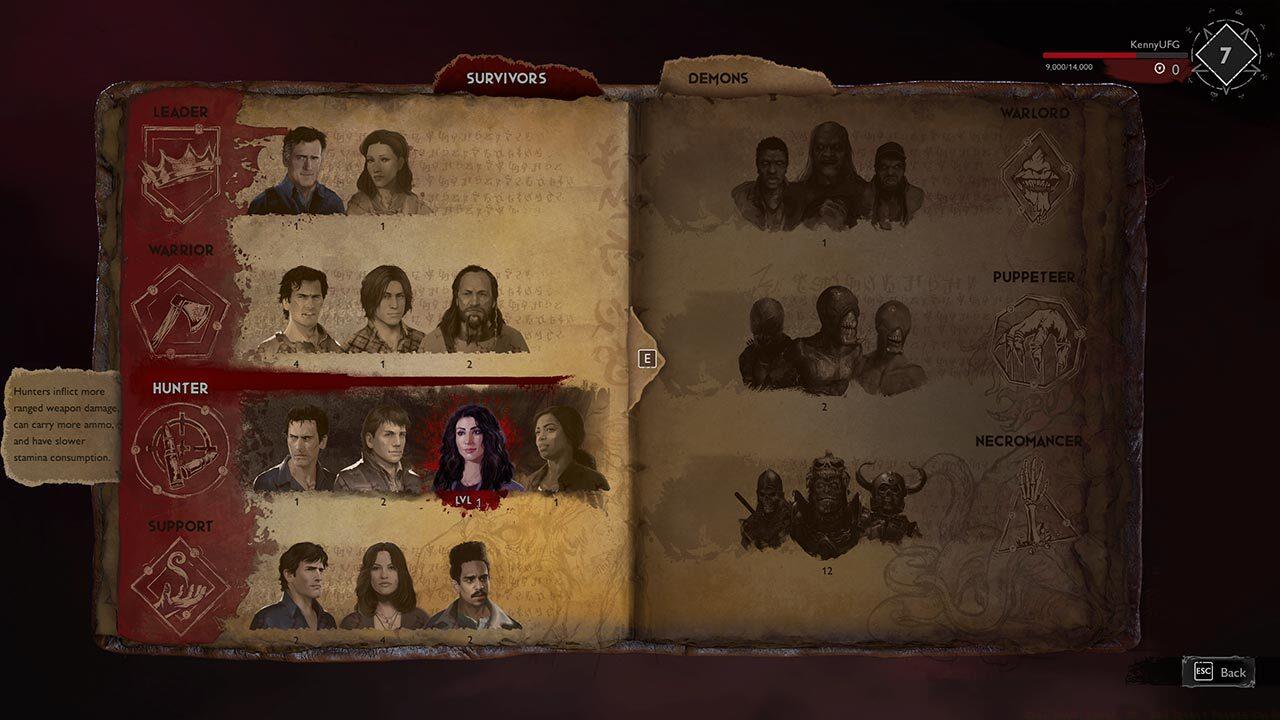
The Collections menu serves as your central hub for character customization and progression management.
Evil Dead’s primary progression mechanism centers on character-specific advancement, where experience points accumulated during matches fuel upgrades. To access Army of Darkness Ash’s premium perks, consistently playing as that character—regardless of match outcome—will gradually unlock his complete passive ability suite.
The Collections interface functions as your upgrade command center, requiring strategic navigation for optimal character development.
Unlocking passive abilities requires accumulating sufficient XP to earn skill points. From the main menu, access the Collections section and select your desired character. Here, you’ll distribute points across various skill categories. As you advance levels and allocate points, additional skill tree branches become accessible. This progression pattern applies equally to survivor characters and Kandarian Demon entities—continued leveling eventually reveals character-specific passive traits.
Every survivor and demon begins with a signature active ability paired with a complementary passive. Reaching new progression milestones unlocks additional passives that enhance each character’s distinctive playstyle. For example, Henry the Red initiates with Unstoppable—an activation skill providing temporary invulnerability. His baseline passive, Shields Up, grants an extra shield bar at match commencement. Upon reaching level 10, Henry unlocks Rebound, a defensive passive that returns a percentage of incoming damage to attackers.
All Evil Dead characters follow this upgrade trajectory. Survivors acquire new passives at levels 10 and 25, while Kandarian Demons receive enhancements at levels 15, 25, and 45.
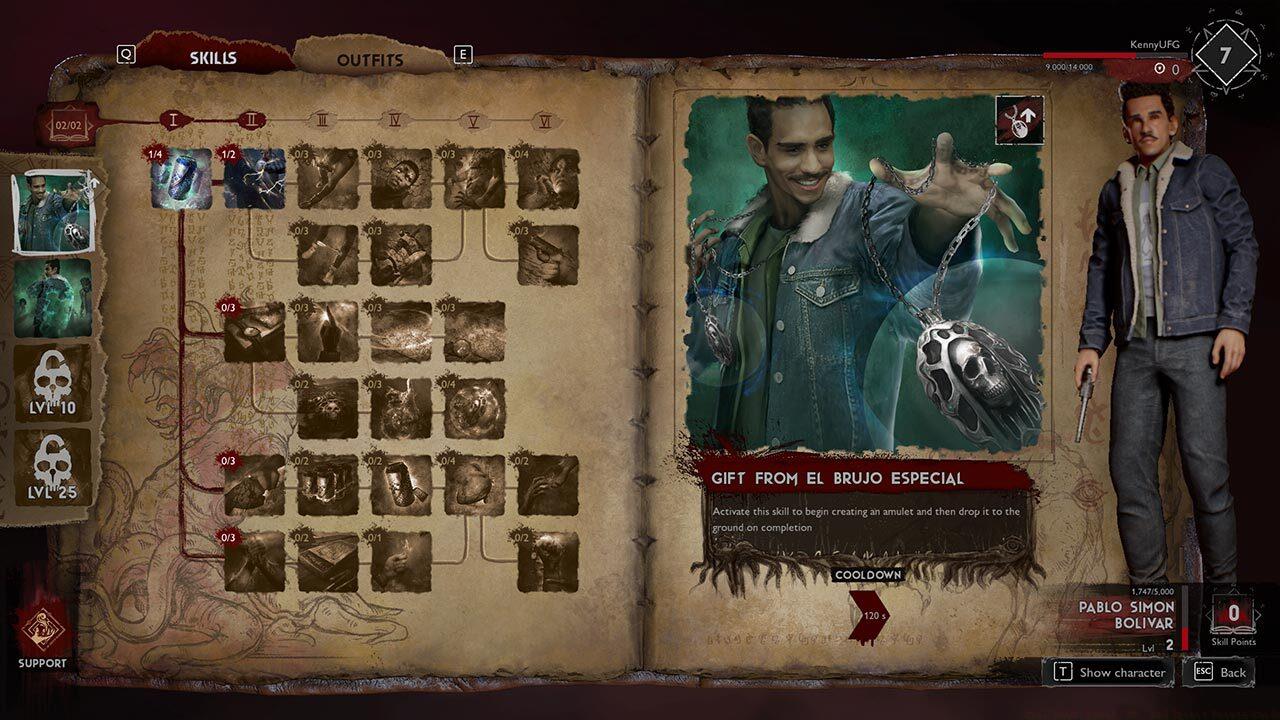
Pablo Bolivar exemplifies strategic survivor selection with unique passive synergies.
Pro Tip: Focus on mastering 2-3 characters initially rather than spreading skill points thinly across multiple characters. This concentrated approach yields faster access to advanced abilities.
Common Mistake: New players often waste early skill points on marginally beneficial upgrades instead of prioritizing core abilities that define their chosen character’s role.
This progression model represents standard practice for asymmetrical PvP gaming environments. The design philosophy aims to incentivize continued engagement through unlockable features that potentially elevate baseline performance capabilities. Regrettably, this configuration introduces balance complications—players with extensive playtime inevitably develop stronger characters than time-constrained participants. Eventually, player ranking distinctions rely more heavily on time investment than pure skill demonstration.
Matchmaking protocols partially alleviate frustrations stemming from progression disparities. Evil Dead’s Spirit Points mechanism (detailed subsequently) performs more effectively in addressing these equilibrium concerns.
Spirit Points Deep Dive: Unlike character-specific XP, Spirit Points accumulate across all gameplay sessions and can be allocated to any character, providing crucial flexibility for experimenting with different playstyles without sacrificing progression efficiency.
Strategic fear management through skill point investment significantly impacts survivor performance and demon strategy effectiveness.
Advanced Strategy: Veteran players recommend reserving 20-30% of Spirit Points for newly released characters, ensuring immediate competitive capability while maintaining existing character development.
Time Optimization: Efficient players can typically unlock a character’s core build within 8-12 hours of focused gameplay, while complete mastery requires approximately 25-30 hours depending on match performance.
For comprehensive gameplay strategies beyond progression systems, consult our Complete Guide to master all aspects of competitive play.
Action Checklist
- Navigate to Collections menu and analyze skill trees for your main characters
- Allocate initial skill points to role-defining abilities rather than marginal upgrades
- Focus on reaching level 10/25 milestones for survivors or 15/25/45 for demons
- Reserve 20-30% of Spirit Points for new character experimentation
- Reference weapon and class guides for complementary build strategies
No reproduction without permission:SeeYouSoon Game Club » Evil Dead: Level, XP, And Spirit Points Guide Master Evil Dead's dual progression systems with expert strategies for character and account leveling optimization