
TL;DR
- Legendary Aspects transform gear and define character builds through Codex of Power and extraction systems
- The Occultist NPC enables aspect extraction, imprinting, and gear stat rerolling in major cities
- Codex Aspects from dungeons provide permanent unlocks while extracted aspects offer better stat rolls
- Strategic timing of imprinting decisions is crucial for maximizing character progression efficiency
- Advanced players should prioritize dungeon completion early and save high-roll aspects for endgame gear
Diablo 4’s Legendary Aspects system represents one of the most impactful progression mechanics in the game, allowing players to fundamentally customize their character’s capabilities. These powerful modifiers can transform ordinary items into legendary gear while enabling deep build specialization that defines your playstyle.
The Codex of Power and Legendary Aspects work synergistically to provide your characters with unique buffs and transformative abilities. By mastering these systems, you can select perks that dramatically shape your build’s effectiveness while converting standard gear pieces into legendary equipment with unique properties.
This comprehensive guide covers everything from basic Occultist functions to advanced optimization strategies for the Codex of Power and Legendary Aspects in Diablo 4, ensuring you maximize your character’s potential throughout the leveling and endgame phases.
The Diablo 4 Occultist NPC serves as your primary interface for legendary power manipulation and can be located in most major settlements and capital cities, including the prominent hub of Kyovashad. These specialized vendors are easily identifiable on your minimap by their distinctive arcane rune symbol, making them simple to find when you need their services.
When interacting with an Occultist, you’ll discover multiple functional tabs and capabilities, including the ability to reroll stat-based affixes on your equipment. However, the two most critical mechanics for character progression involve Legendary Aspects: specifically, the extraction of aspects from existing gear and the imprinting of aspects onto new items.
Pro Tip: Visit the Occultist immediately upon reaching Kyovashad to familiarize yourself with the interface before you have valuable aspects to manage. This prevents costly mistakes when handling high-value legendary powers later in your journey.
Before diving into extraction mechanics, it’s essential to understand the primary source of Legendary Aspects: the Diablo 4 Codex of Power. Access this vital resource by opening the main menu and navigating to the Collections tab, where you’ll find the complete Codex displaying all Legendary Aspects obtainable through dungeon completion. You can filter the display to show only aspects relevant to your current class alongside universally applicable general powers.
After selecting a specific Legendary Aspect from the Codex, you can pin its location to generate a waypoint marker on your world map. Use this navigation aid to direct your travels toward the target dungeon’s position. Be aware that certain dungeon locations remain inaccessible until you’ve successfully cleared corresponding Stronghold locations in the surrounding regions.
Venture deep into these challenging dungeons, complete their specific objectives, and defeat the final boss encounter. Upon successful completion, you’ll permanently unlock that specific Legendary Aspect within your Codex of Power. For detailed information about these activities, consult our comprehensive dungeon locations guide.


Left: The Sorcerer’s Aspect of Conflagration in the Codex of Power; Right: Clearing the dungeon to obtain the Aspect of Conflagration
Common Mistake: Many players overlook Stronghold prerequisites and waste time traveling to inaccessible dungeons. Always check your map for Stronghold indicators near dungeon entrances before embarking on your journey.
The alternative method for acquiring Diablo 4 Legendary Aspects involves extracting them directly from legendary items you’ve collected. This process is exclusively handled through the Occultist’s dedicated extraction interface.
Consider this scenario: you acquire a level 25 legendary gloves piece but no longer wish to equip it. If the aspect attached to this item possesses desirable properties, you can extract this power. This action will permanently destroy the original item while transferring the aspect to one of your inventory storage tabs for future use.
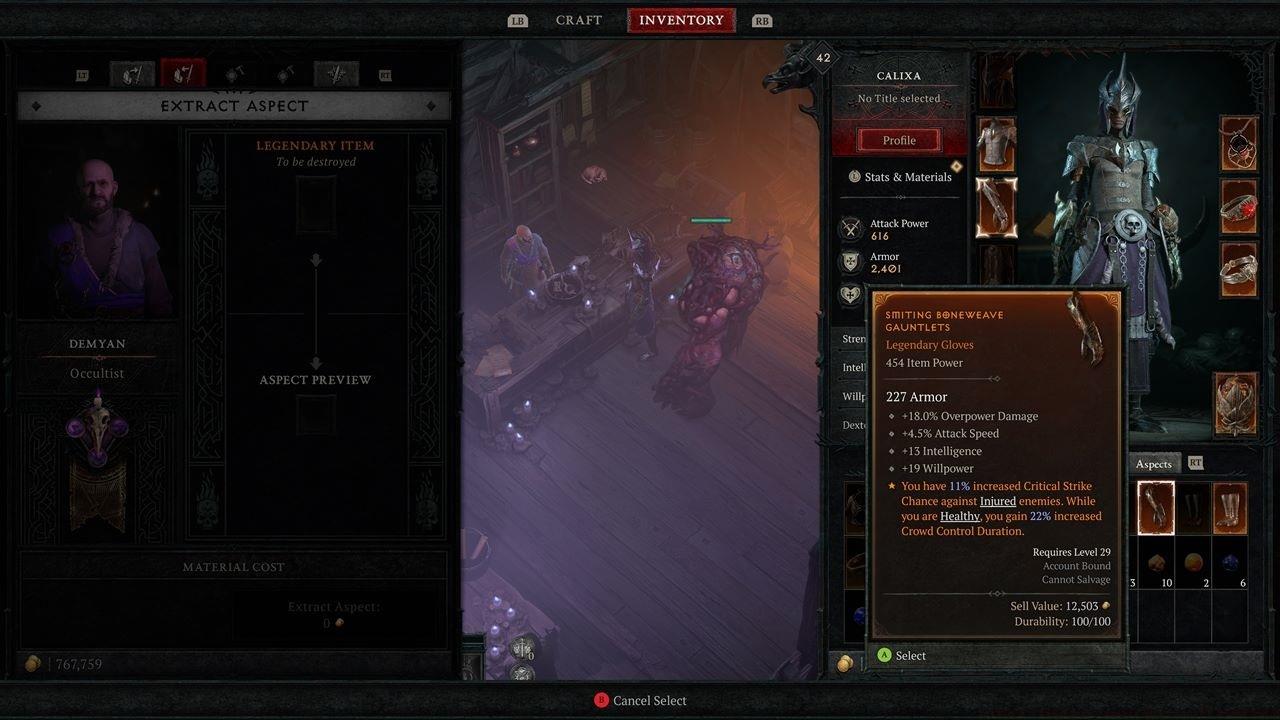
Extracting a Legendary Aspect from a gear piece
Strategic Insight: Extraction becomes particularly valuable when you find legendary items with perfectly rolled stat coefficients that exceed the fixed values available from Codex of Power aspects. These superior rolls can significantly enhance your build’s performance when applied to appropriate gear.
Now we reach the most crucial Diablo 4 Legendary Aspect concept: imprinting. Also performed through the Occultist’s interface, think of this process as transferring a legendary perk to another item, effectively converting it into legendary quality. Here are the essential details:
- Legendary Aspects typically have specific gear slot requirements (for example, some can only be applied to weapons and off-hand items, while others are restricted to rings and amulets). Pay close attention to the associated iconography and detailed tooltip descriptions.
- Generally, aspects unlocked through dungeon completion (those from the Diablo 4 Codex of Power) can be used repeatedly without limitation. Ensure you possess the necessary crafting materials before attempting the imprinting process.
- Conversely, aspects extracted from legendary items are strictly single-use consumables, though you may acquire (a) multiple copies depending on legendary drop frequency, and (b) potentially superior stat rolls with enhanced numerical coefficients.
- Although the Codex of Power and dungeon rewards provide extensive options, numerous powerful aspects exclusively originate from random item drops. These must be extracted if you wish to transfer their power to other equipment.
- The recipient item receiving an imprinted aspect will maintain its original power level and statistical attributes. However, if the base item isn’t already legendary, it will be elevated to legendary status through the addition of the aspect affix.
- Following the imprinting of an aspect, you cannot extract it again from the modified item. Consequently, the strategic decision rests with you regarding when to imprint a valuable aspect (if you urgently require it on a more powerful gear piece), or whether to preserve it for potential future use when superior equipment becomes available.
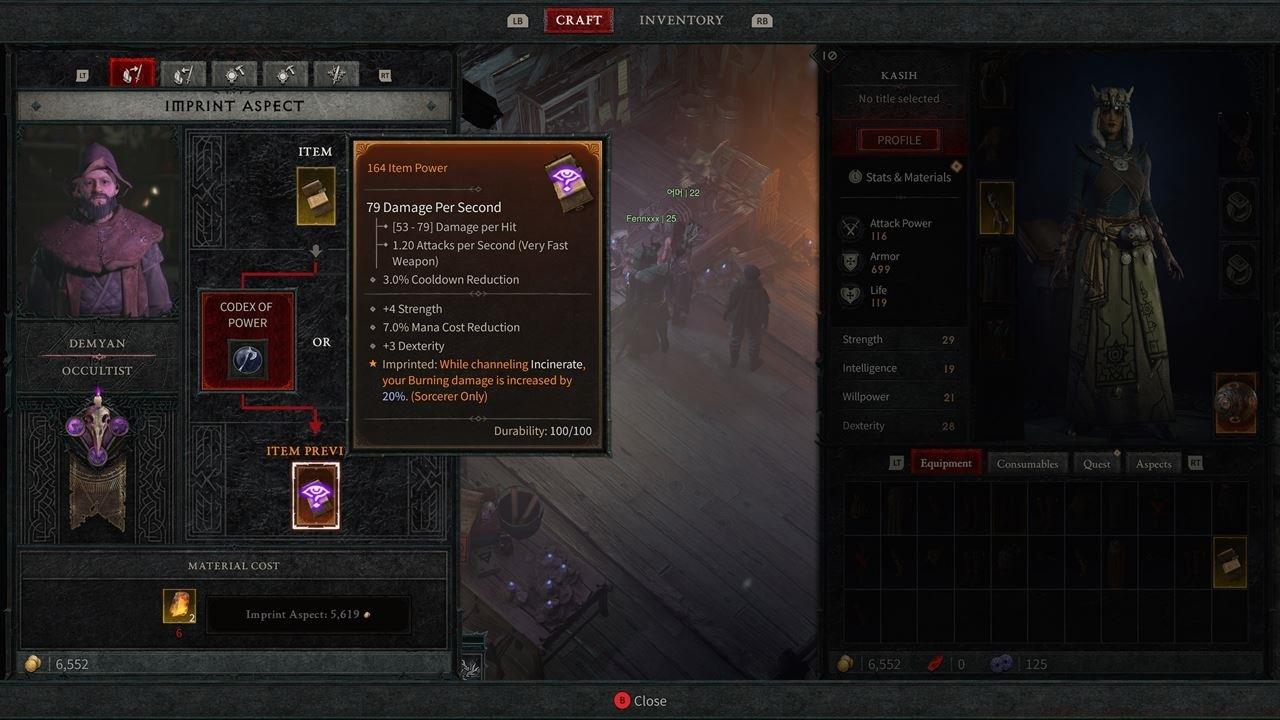
Imprinting a Legendary Aspect on another item
Advanced Optimization: Seasoned players should prioritize imprinting Codex aspects on leveling gear while reserving high-roll extracted aspects for ancestral and sacred items encountered during endgame content.
Mastering the timing of your imprinting decisions represents one of the most sophisticated aspects of Diablo 4’s progression systems. Imprinting too early can waste valuable aspects on quickly-outdated equipment, while delaying too long may hinder your character’s power progression during critical content phases.
Resource Management Strategy: The materials required for imprinting become increasingly scarce at higher world tiers. Plan your aspect usage around anticipated gear upgrades, typically every 10-15 levels during the leveling process, and at major power spikes when transitioning between world tiers.
Build Synergy Considerations: When planning your aspect usage, consider how different legendary powers interact with your chosen skills and other equipment. Some aspects create powerful synergistic combinations that dramatically outperform their individual components.
Ultimately, Diablo 4’s Legendary Aspects and Codex of Power mechanics significantly enhance character customization and build theorycrafting when developing effective combat strategies. Expand your knowledge through our specialized Legendary Aspects guide series covering the Necromancer, Sorcerer, and Rogue classes.
Diablo 4 features numerous character classes, intricate mechanics, and diverse activities. For additional game information, explore our comprehensive D4 guides hub for detailed walkthroughs and advanced tactics.
Action Checklist
- Locate and familiarize yourself with the Occultist NPC in Kyovashad
- Review your Codex of Power and identify key dungeons for your build
- Complete prioritized dungeons to unlock permanent Codex aspects
- Extract high-roll legendary aspects from replaceable gear
- Strategically imprint aspects following the 10-15 level upgrade rule
- Save premium extracted aspects for ancestral/sacred endgame gear
No reproduction without permission:SeeYouSoon Game Club » Diablo 4 – Legendary Aspects And Codex Of Power Guide Master Diablo 4's Legendary Aspects system with advanced strategies for Codex of Power and Occultist mechanics