
TL;DR
- Team Deathmatch features 6v6 combat with 30-kill win condition and unique spawn systems
- Octane dominates with passive health regeneration complementing automatic shield recovery mechanics
- Weapon selection requires complementary range coverage and strategic ammo conservation
- Aggressive playstyles outperform defensive approaches due to unlimited respawns
- Advanced loot acquisition from care packages and Loot Ticks provides competitive advantages
Mastering Apex Legends Mobile’s Team Deathmatch requires understanding its unique combat dynamics and rule systems that differ significantly from traditional battle royale gameplay.
The mobile adaptation brings Respawn Entertainment’s acclaimed shooter to handheld devices, maintaining core gameplay while introducing exclusive modes. Team Deathmatch stands out as a fast-paced alternative where two squads of six compete in confined arenas, prioritizing elimination efficiency over survival tactics.
Team Deathmatch operates as a 6v6 elimination contest where victory goes to the first team achieving 30 confirmed kills. Each squad must maintain unique Legend selections, preventing duplicate characters within teams. Players begin matches with customized weapon loadouts selected from extensive armories, though certain high-tier firearms remain restricted initially. Two distinct spawn variations exist: base spawning that returns players to team headquarters, and random spawning that distributes combatants unpredictably across the battlefield. Base spawning carries strategic risks, as demonstrated in multiple engagements where dominant teams successfully trapped opponents in spawn zones, creating frustrating but preventable scenarios.
Apex Legends Mobile features a curated Legend roster reminiscent of the game’s inaugural season, enhanced by Fade, the platform-exclusive character. Ultimate abilities maintain charge progression between respawns, making offensive-oriented Legends like Bangalore and Caustic particularly valuable for consistent pressure application. Defensive and support specialists like Lifeline face significant limitations in this mode, particularly since revival mechanics remain disabled entirely. Octane currently dominates the Team Deathmatch meta due to his Swift Mend passive, which automatically restores health following damage avoidance periods. This synergizes perfectly with the mode’s automatic shield regeneration, creating continuous sustainability that reduces downtime between engagements.
Successful players maintain flexible Legend preferences when entering matchmaking, since all six squad members must select distinct characters. The simultaneous selection process creates competitive pressure, requiring quick decision-making to secure preferred combatants before teammates.
Common selection mistakes include over-prioritizing defensive Legends, ignoring team ability synergy, and failing to adapt to opponent compositions. Advanced players typically master 3-4 different Legends to ensure adaptability while maintaining personal performance standards.
You have access to most weapons in Apex Legends Mobile in Team Deathmatch.
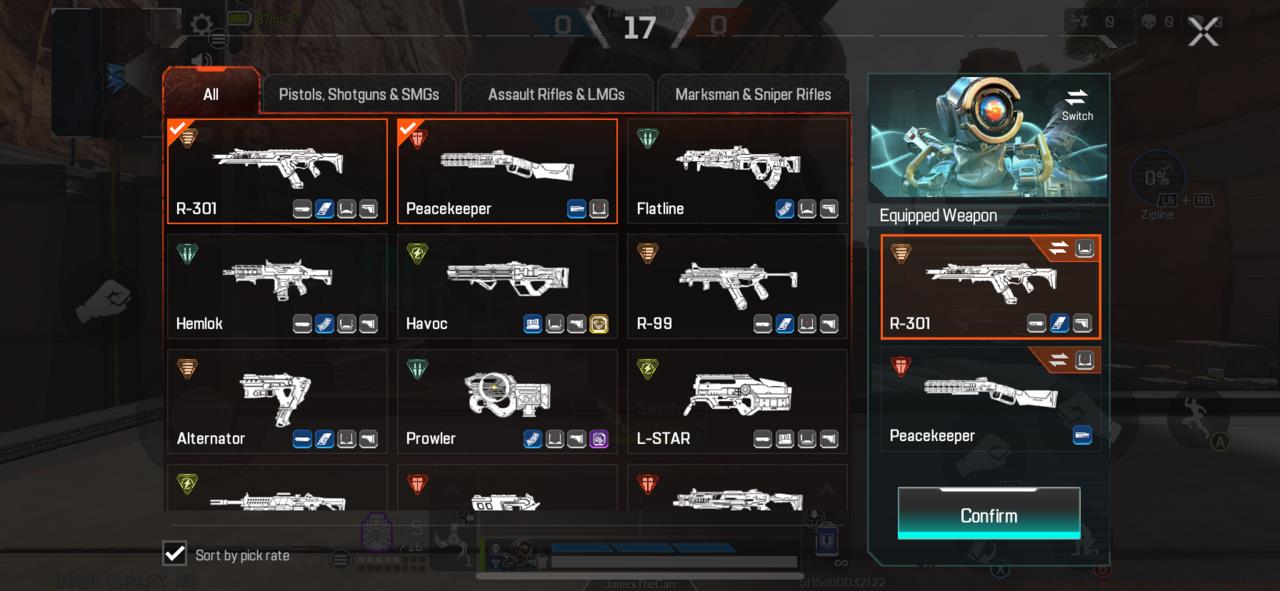
Strategic weapon selection significantly impacts Team Deathmatch performance outcomes.
Weapon configuration represents one of the most critical strategic decisions in Team Deathmatch. Players select primary and secondary firearms from the standard inventory pool, excluding care package exclusives like the Volt and Spitfire initially, though these may appear during matches via airdrops. Optimal loadouts combine complementary weapons covering multiple engagement ranges while aligning with personal proficiency. The R-301 and Peacekeeper combination exemplifies effective range coverage, providing reliable medium-distance performance alongside devastating close-quarters capability. Experimentation remains encouraged, as weapon preferences can be adjusted following each respawn, allowing tactical adaptation to evolving match conditions.
Ammunition systems function uniquely within Team Deathmatch parameters. Traditional ammo drops disappear from maps entirely, and eliminated opponents don’t relinquish spare rounds. Instead, ammunition reserves attach directly to individual weapons, which become retrievable upon user elimination. Initial spawn allocations provide substantial reserves, though extended kill streaks may exhaust supplies. The exclusive resupply method involves collecting discarded weapons from fallen combatants, adding strategic looting to elimination priorities.
All participants begin with standardized armor configurations and identically equipped weapons. However, superior equipment becomes available through map exploration, including care package deliveries and strategically hidden Loot Ticks containing enhanced attachments and improved protective gear.
Aggressive positioning, even bordering on reckless advancement, proves fundamentally advantageous in Team Deathmatch. While battle royale success rewards survival proficiency alongside combat effectiveness, TDM’s unlimited respawns transform tactical calculations. Prioritizing elimination efficiency over personal survival consistently benefits team performance, provided players maintain positive kill-to-death ratios. Despite respawn availability, minimizing deaths remains valuable for sustained map control and objective pressure. Unlimited shield cells and syringes ensure constant healing availability, though understanding regeneration sequencing optimizes recovery speed. Shield regeneration activates automatically following damage cessation, making syringe application the priority healing action for rapid re-engagement.
Advanced positioning techniques involve controlling high-traffic corridors while avoiding predictable spawn patterns. Team coordination separates average performers from dominant squads, with communication about enemy positions and coordinated pushes creating overwhelming advantages. Understanding each map’s power positions and loot spawn locations typically requires 5-10 matches of focused observation and experimentation.
Weapon mastery progression follows identifiable patterns, with most players achieving basic proficiency within 3-5 matches, while advanced weapon mastery may require 15-20 dedicated games. Team Deathmatch serves as an excellent training environment for weapon familiarization and mechanical skill development applicable across all game modes.
Action Checklist
- Master 3-4 different Legends to ensure selection flexibility and team synergy
- Create complementary weapon loadouts covering multiple engagement ranges
- Practice aggressive positioning while maintaining positive kill-death ratios
- Learn map-specific loot locations and power positions through exploration
- Coordinate with teammates for spawn trapping prevention and focused eliminations
No reproduction without permission:SeeYouSoon Game Club » Apex Legends Mobile: Tips For Team Deathmatch Master Apex Legends Mobile Team Deathmatch with expert strategies, weapon selection tips, and advanced gameplay techniques