
Mastering Neon’s movement mechanics and slide canceling techniques to dominate Valorant matches
Introduction: Valorant’s Movement Revolution
Valorant’s latest agent addition, Neon, brings an unprecedented level of mobility to Riot’s tactical shooter with movement capabilities that directly challenge the game’s traditional pacing and positioning fundamentals.
As Valorant’s 18th agent, Neon represents a significant departure from established movement mechanics, featuring rapid sliding abilities that immediately drew comparisons to Call of Duty’s signature slide canceling techniques that dominate modern warfare titles.
Historically, Valorant has occupied a strategic middle ground between CS:GO’s methodical approach and Overwatch’s hero-driven chaos. Players transitioning from either franchise discovered that Valorant demands unique adaptations—movement is more restricted than Overwatch’s fluid combat, while the agent abilities add complexity beyond CS:GO’s pure gunplay fundamentals. Neon’s introduction disrupts this carefully balanced ecosystem entirely. Her gameplay trailer demonstrates continuous aggressive movement, sliding between cover while maintaining perfect shooting accuracy, creating new threats to the angle-holding strategies that previously defined high-level Valorant play.
Neon’s Movement Mechanics Deep Dive
 Riot Games
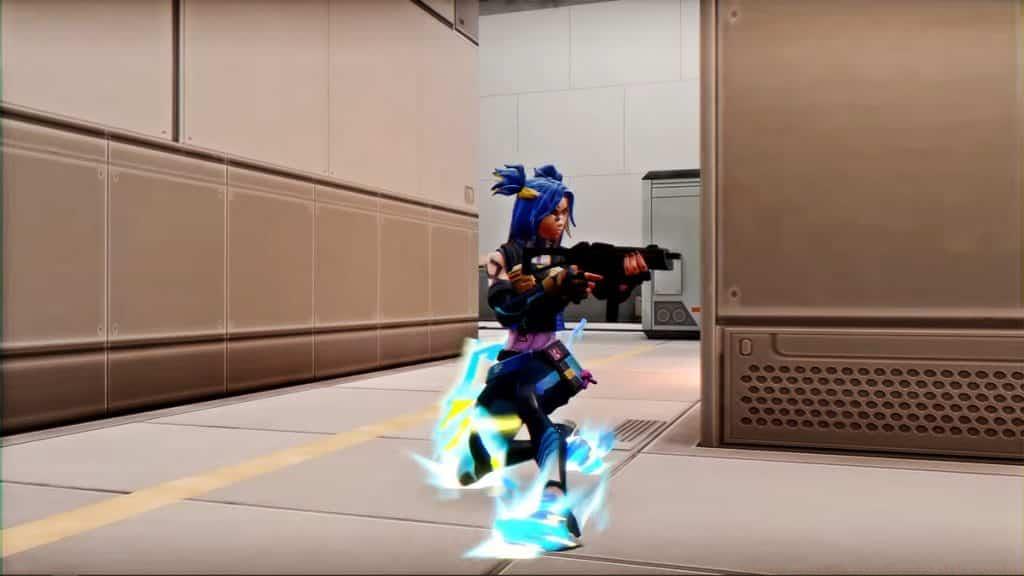
Valorant’s newest agent Neon introduces sliding mechanics reminiscent of Call of Duty’s movement system.The introduction of sliding mechanics marks Valorant’s first significant convergence with Call of Duty’s fast-paced combat philosophy. While previous comparisons focused on CS:GO and Overwatch, Neon’s slide ability creates a direct mechanical bridge to CoD’s movement ecosystem. This is particularly notable because Call of Duty emphasizes constant motion and aggressive positioning, whereas Valorant traditionally rewards patient angle control and calculated peeks.
Call of Duty’s slide canceling mechanic has become essential advanced tech in titles like Warzone and Vanguard, allowing players to maintain momentum while becoming harder targets during engagements. This technique involves interrupting slides at specific frames to reset movement cooldowns, creating fluid motion chains that skilled players utilize for both traversal and combat evasion. Neon’s implementation appears to offer similar capabilities, enabling rapid changes of position that could redefine how players approach site takes, retakes, and one-versus-many scenarios.
Advanced Slide Canceling Techniques
Mastering Neon’s slide mechanics requires understanding several advanced techniques. Optimal slide initiation timing is crucial—initiating slides at the peak of sprint momentum maximizes distance covered while minimizing exposure time. Additionally, learning to cancel slides into immediate actions like weapon swapping or ability usage creates seamless combat transitions that catch opponents off-guard.
Common mistakes include sliding predictably in straight lines, failing to account for slide audio cues that alert enemies, and overusing the mechanic in situations where traditional positioning would be safer. Advanced players should practice slide-into-cover techniques where the momentum carries them behind protection while maintaining offensive sightlines. Map-specific applications vary significantly—slides excel on open sites like Ascent’s mid-court but become riskier in confined spaces like Split’s B site corridors.
Optimization tips include binding slide to easily accessible keys, practicing slide-shot accuracy in custom games, and developing situational awareness for when slides provide tactical advantages versus when they create predictable movement patterns that skilled opponents can punish.
Community Response and Meta Impact
The community reaction to Neon’s slide mechanics has been sharply divided since her reveal. Social media platforms exploded with discussions comparing her movement to Call of Duty’s signature techniques, with many players expressing excitement about the fresh gameplay possibilities while others voiced concerns about compromising Valorant’s strategic identity.
Professional players and content creators quickly identified the competitive implications, with many noting that Neon’s slide ability could revolutionize entry fragging and site execution strategies. The mechanic introduces new counterplay considerations for defenders, who must now account for rapid repositioning during holds rather than traditional slow peeks. This development has sparked debates about whether Valorant is evolving toward a more dynamic combat system or drifting from its tactical roots.
Neon became available on January 12, 2022, marking a pivotal moment in Valorant’s evolution. Players now face adapting to a meta where traditional angle-holding strategies meet hyper-mobile threats that can rapidly close distances and create unexpected engagement angles. This fundamental shift demands revised defensive setups, new communication protocols for tracking mobile threats, and adjusted crosshair placement to account for sliding targets.
No reproduction without permission:SeeYouSoon Game Club » Valorant Agent Neon introduces CoD slide canceling Mastering Neon's movement mechanics and slide canceling techniques to dominate Valorant matches