
Master Genshin Impact’s Operation Downpour Simulation with strategic unit deployment and advanced battle tactics
Understanding Operation Downpour Simulation Mechanics
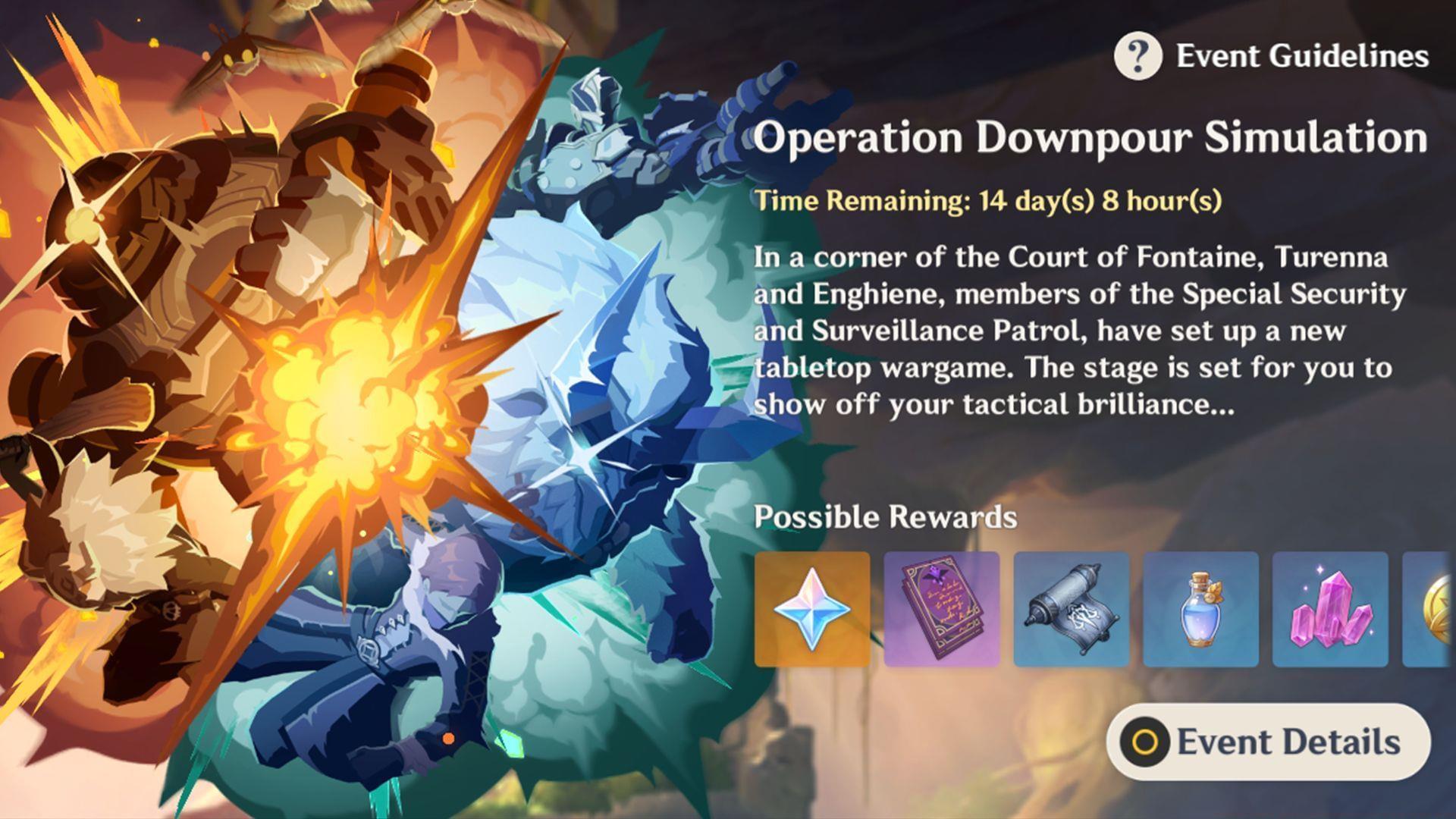
The Operation Downpour Simulation introduces a fresh tactical experience within Fontaine’s latest update, transforming combat into a cerebral tabletop wargame format. This event demands players to think several moves ahead, analyzing battlefield conditions before committing units to action. Your primary objective across all engagements remains consistent: eliminate every hostile entity and destructible structure while minimizing losses through intelligent deployment decisions.
This strategic framework operates on fundamental wargame principles where you command both offensive and defensive units with distinct combat roles. The roster divides cleanly into two primary categories: melee specialists who aggressively advance toward targets, and ranged combatants who maintain positional advantage while delivering sustained damage. Understanding these behavioral patterns forms the foundation of successful battlefield management.
Melee units exhibit predictable charging behavior, relentlessly pushing toward enemy positions while clearing obstructive elements from their path. Conversely, ranged units maintain static firing positions, only redirecting attacks when their current target falls. The five-unit deployment limit forces careful consideration of unit composition, as overcrowding can lead to inefficient positioning and vulnerability to area attacks.
Challenge Walkthroughs: Strategy Breakdowns
Early Challenges (1-4): Foundation Building
Challenge 1 introduces basic unit mechanics against Cryo Whopperflowers using Hilichurl Fighters and Electro Samachurls. The symmetrical deployment strategy—positioning identical units on both flanks—creates a pincer movement that overwhelms simple enemy formations. This approach teaches fundamental positioning without overwhelming new players with complexity.
Challenge 2 escalates difficulty with Hydro Slimes and Treasure Hoarder Pyro Potioneers, introducing Ruin Guards as durable frontline units. Their exceptional damage absorption allows supporting units to operate safely from behind. Deploying all forces along the bottom creates a concentrated assault force that systematically dismantles enemy defenses.
Challenge 3 incorporates Frostarm Lawachurls alongside Pyro Potioneers, requiring sequenced deployment to manage tougher enemies. Beginning with Cryo Specters establishes ranged superiority before committing Electro Samachurls for elemental support. The delayed Ruin Guard deployment ensures they engage when enemy attention is divided.
Challenge 4 introduces the Eroding Avatars of Lava against Suppression Specialist Mek: Ousia and Cryo Whopperflowers. The phased approach—starting with durable melee units and staggered Electro Cicin deployments—demonstrates how to manage multiple threat types simultaneously while preserving unit effectiveness.
Intermediate Challenges (5-8): Tactical Complexity
Challenge 5 introduces environmental hazards with Shackling Mines against Suppression Specialist Meks and Hydro Slimes. Strategic sacrifice becomes necessary here, as deploying Cryo Specters to eliminate distant threats allows subsequent melee units to bypass some mine effects. This teaches resource allocation and acceptable loss calculations.
Challenge 6 focuses on minefield navigation against Treasure Hoarder Pyro Potioneers with Anti-Personnel Mines. The split deployment strategy—using ranged units to clear initial threats before committing mobile melee units—showcases how to minimize mine damage while maintaining offensive pressure.
Challenge 7 combines Large Hydro Slimes and Pyro Potioneers with a mixed unit roster. The flanking deployment of Ruin Guards and Electro Samachurls creates crossfire situations that overwhelm enemy defenses. The reinforcement strategy of deploying backup Hilichurl Fighters when losses occur demonstrates adaptive battlefield management.
Challenge 8 features Frostarm Lawachurls and Pyro Potioneers with specialized unit roles. The protective formation using Ruin Guards as damage sponges while Hilichurl Grenadiers provide supporting fire illustrates effective tank-and-spank tactics. Simultaneous Electro Samachurl placements on both flanks prevent enemy consolidation.
Advanced Challenges (9-11): Mastery Requirements
Challenge 9 represents a significant difficulty spike with Frostarm Lawachurls, Suppression Specialist Mek: Ousia, and Cryo Whopperflowers. The intricate deployment sequence—starting with Electro Cicins and Eroding Avatars, then carefully timing Cryo Specter placements to avoid Mek counters—demands precise execution and threat awareness.
Challenge 10 combines multiple hazard types with Treasure Hoarder Pyro Potioneers, Cryo Whopperflowers, Shackling Mines, and Anti-Personnel Mines. The multi-vector assault using Hydro Mimic Finches to distract, followed by concentrated bottom-side deployment, showcases advanced zone control techniques.
The final challenge tests everything learned against Frostarm Lawachurls, Suppression Specialist Mek: Ousia, Hydro Slimes, Pyro Potioneers, and Anti-Personnel Mines. The layered deployment strategy using Cryo Specters for initial coverage, followed by staggered melee commits and strategic reinforcements, represents peak tactical execution for this game mode.
Advanced Tactics and Common Mistakes
Successful Operation Downpour Simulation play requires understanding unit synergies beyond basic deployment. Electro-based ranged units paired with Hydro melee attackers create elemental reactions that significantly increase damage output. Similarly, Cryo units can control enemy movement when combined with area denial specialists.
Avoid these common errors: deploying all units simultaneously (creates target-rich environments for enemies), ignoring environmental hazards (mines can decimate unprepared forces), and failing to adapt to enemy composition (certain units counter specific enemy types). Advanced players should master deployment timing—sometimes delaying unit placement until enemies commit to specific actions creates advantageous engagements.
Unit preservation becomes crucial in later challenges. Rather than treating units as disposable, consider each deployment as an investment. If a unit isn’t providing value relative to its position, consider repositioning or combining it with complementary units. The reinforcement mechanic allows strategic sacrifice of weaker units to protect more valuable assets.
PvP Confrontation Scenario Guide
Beyond the single-player challenges, Operation Downpour Simulation offers competitive PvP through the Confrontation Scenario mode. This reverses the gameplay dynamic, requiring you to construct defensive formations while simultaneously preparing offensive strategies. Victory goes to the player who either completely destroys the enemy base first or achieves superior damage within the time limit.
The six provided defense templates offer varying strategic approaches, from concentrated fortress designs to distributed defensive networks. Experimentation across multiple matches reveals which formations best counter common attack patterns. Strategic unit placement within these formations—positioning ranged units behind defensive structures, for example—can create kill zones that devastate unprepared attackers.
Offensive lineup customization requires balancing melee and ranged units to handle diverse enemy formations. A common mistake is over-specializing in one unit type, making your forces vulnerable to specific counters. The defense simulation feature provides invaluable intelligence about formation weaknesses before committing to live matches.
Final preparation involves analyzing simulation results and adjusting both defensive layouts and attack compositions. This iterative refinement process separates casual participants from competitive contenders in the PvP arena.
No reproduction without permission:SeeYouSoon Game Club » Genshin Impact Operation Downpour Simulation event guide Master Genshin Impact's Operation Downpour Simulation with strategic unit deployment and advanced battle tactics