
TL;DR
- Cranberries offer the best balance of continuous production and profit per season
- Artichokes and pumpkins provide high single-harvest returns but require careful timing
- Sweet Gem Berries deliver maximum value but need long-term investment planning
- Community Center bundles may require growing lower-profit crops strategically
- Advanced techniques like quality fertilization can increase profits by 25-50%
Stardew Valley’s autumn season presents unique agricultural opportunities that can significantly boost your farm’s revenue stream. Understanding the economic dynamics of fall crops is crucial for maximizing your seasonal earnings and building long-term wealth.
When planning your fall planting strategy, you need to consider multiple financial factors beyond simple sell prices. The most critical metrics include initial seed investment, growth cycle duration, harvest frequency, and potential quality bonuses. Crops like cranberries, despite having lower individual sell prices, generate exceptional returns due to their continuous production pattern throughout the season.
The most profitable crops to cultivate during autumn are cranberries, artichokes, pumpkins, and grapes. Each offers distinct advantages: cranberries provide steady income, artichokes deliver excellent value for their growth time, pumpkins offer premium single-harvest returns, and grapes combine decent profits with frequent harvesting.
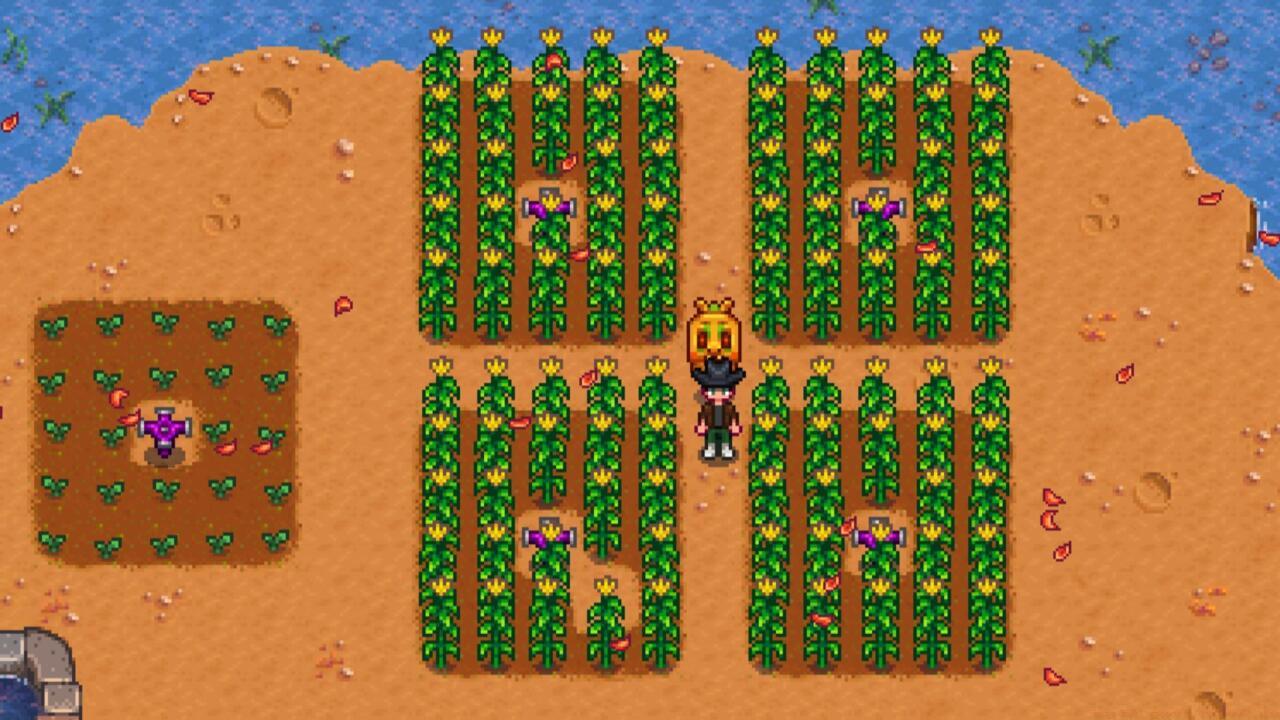
Corn fields demonstrate the importance of seasonal timing for multi-season crops.
Many farmers overlook the importance of calculating profit per day rather than profit per harvest. For example, while pumpkins sell for 320G each, their 13-day growth period means they generate approximately 24.6G per day, whereas cranberries—despite lower per-unit value—can produce up to 45G daily when factoring in their continuous production cycle.
Your farming objectives should directly influence which fall crops you prioritize. Are you focused on rapid cash generation, completing community bundles, or building toward end-game wealth? Each goal requires a different crop selection strategy.
For players working toward community center completion and Greenhouse unlocking, you’ll need to strategically incorporate lower-value crops like corn and eggplant. The key is planting these requirement crops in minimal quantities while dedicating most of your farmland to high-profit varieties.
Cranberries represent the most beginner-friendly option due to their self-sustaining production cycle. Once planted, they continue yielding berries every five days after the initial week-long growth, eliminating replanting costs and labor. This makes them ideal for farmers who want consistent income without constant field management.
Pumpkins deliver substantial payouts but their extended 13-day maturation means you can only achieve two harvests per season with precise timing. For players who prefer larger, less frequent paydays, pumpkins and artichokes provide excellent value, though artichoke seeds only become available starting in year two.
Advanced players should consider Sweet Gem Berries for maximum profit potential, despite their significant limitations. These ultra-valuable crops require rare seeds from the Traveling Cart and take 24 days to mature, making them a long-term investment rather than immediate income solution.
Beyond basic crop selection, several advanced techniques can dramatically increase your fall farming profits. Understanding game mechanics like quality levels, processing options, and fertilizer effects separates profitable farmers from struggling ones.
Quality fertilizer application can boost your earnings by 25-50% depending on the crop. For high-value single harvest crops like pumpkins, quality bonuses provide substantial additional income, while for continuous producers like cranberries, the cumulative effect across multiple harvests can be enormous.
Many players make the critical mistake of undervaluing processing opportunities. Turning cranberries into jelly increases their value significantly, while pumpkins become even more valuable when processed into pickles. Always calculate whether processing time and resource investment justifies the increased returns.
Season transition planning is another often-overlooked strategy. Since fall has 28 days, you can plant crops with specific growth patterns to maximize field utilization. For instance, planting cranberries early ensures multiple harvest cycles, while timing pumpkin planting allows for two complete harvests with careful scheduling.
For comprehensive farming strategies beyond seasonal crops, check out our Complete Guide for detailed progression systems.
Below you’ll find comprehensive data for every autumn crop available in Stardew Valley. This table includes seed costs, growth durations, and sell prices across all quality tiers. Note that these figures represent base values without agricultural profession bonuses, fertilizer effects, or processing enhancements.
| Crop | Seed Price | Growth Time (days) | Sell Price |
|---|---|---|---|
| Amaranth | 70G | 7 |
Normal: 150G Silver: 187G Gold: 225G Iridium: 300G |
| Artichoke | 30G | 8 |
Normal: 160G Silver: 200G Gold: 240G Iridium: 320G |
| Beet | 20G (Oasis) | 6 |
Normal: 100G Silver: 125G Gold: 150G Iridium: 200G |
| Bok Choy | 50G | 4 |
Normal: 80G Silver: 87G Gold: 105G Iridium: 140G |
| Fairy Rose | 200G | 12 |
Normal: 290G Silver: 362G Gold: 435G Iridium: 580G |
| Pumpkin | 100G | 13 |
Normal: 320G Silver: 400G Gold: 480G Iridium: 640G |
| Sunflower | 200G | 8 |
Normal: 80G Silver: 100G Gold: 120G Iridium: 160G |
| Sweet Gem Berry | 1,000G (Traveling Cart) | 24 |
Normal: 3,000G Silver: 3,750G Gold: 4,500G Iridium: 6,000G |
| Wheat | 10G | 4 |
Normal: 25G Silver: 31G Gold: 37G Iridium: 50G |
| Yam | 60G | 10 |
Normal: 160G Silver: 200G Gold: 240G Iridium: 320G |
| Corn | 150G | 14 for initial growth, produces every 4 after |
Normal: 50G Silver: 62G Gold: 75G Iridium: 100G |
| Cranberries | 240G | 7 for initial growth, produces every 5 after |
Normal: 75G Silver: 93G Gold: 112G Iridium: 150G |
| Eggplant | 20G | 5 for initial growth, produces every 5 after |
Normal: 60G Silver: 75G Gold: 90G Iridium: 120G |
|
Broccoli |
Foraged | 8 for initial growth, produces every 4 after |
Normal: 70G Silver: 87G Gold: 105G Iridium: 140G |
| Grape | 60G | 10 for initial growth, produces every 3 after |
Normal: 80G Silver: 100G Gold: 120G Iridium: 160G |
For specialized strategies on equipment and character development that complement your farming approach, explore our Weapons Unlock guide for tactical advantages.
Action Checklist
- Calculate your available farming space and budget for seed purchases
- Prioritize cranberries for 60% of your field for consistent income
- Plant pumpkins and artichokes in remaining space for high-value harvests
- Apply quality fertilizer to maximize profit from single-harvest crops
- Check Traveling Cart weekly for Sweet Gem Berry seeds for long-term investment
No reproduction without permission:SeeYouSoon Game Club » Best Fall Crops In Stardew Valley Maximize your Stardew Valley fall profits with strategic crop selection and advanced farming techniques